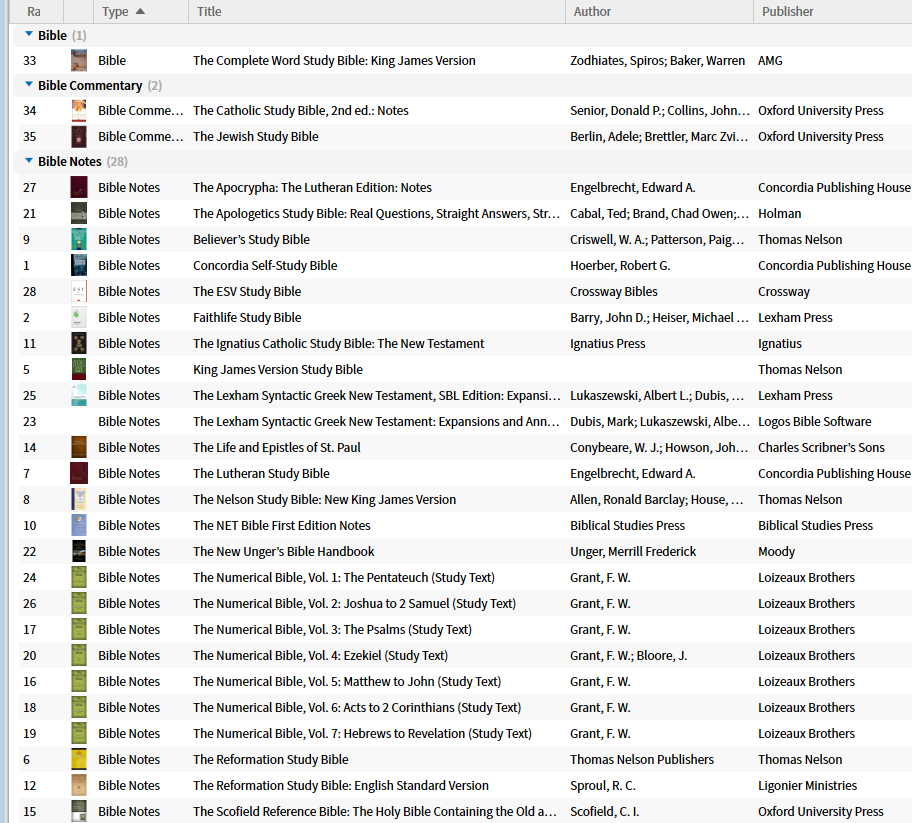
The following are not type:Bible Notes which all other study Bibles are:
The following are not type:Bible Notes which all other study Bibles are: The Complete Word Study Bible The Catholic Study Bible, 2nd edition The Jewish Study Bible
I will notify the correct department to get this fixed. [:)]
M.J. I have a couple of comments/questions for you.
As for the later two:
I'd rather keep it as a resource type of Bible
So would I - it's analogous to an interlinear bible.
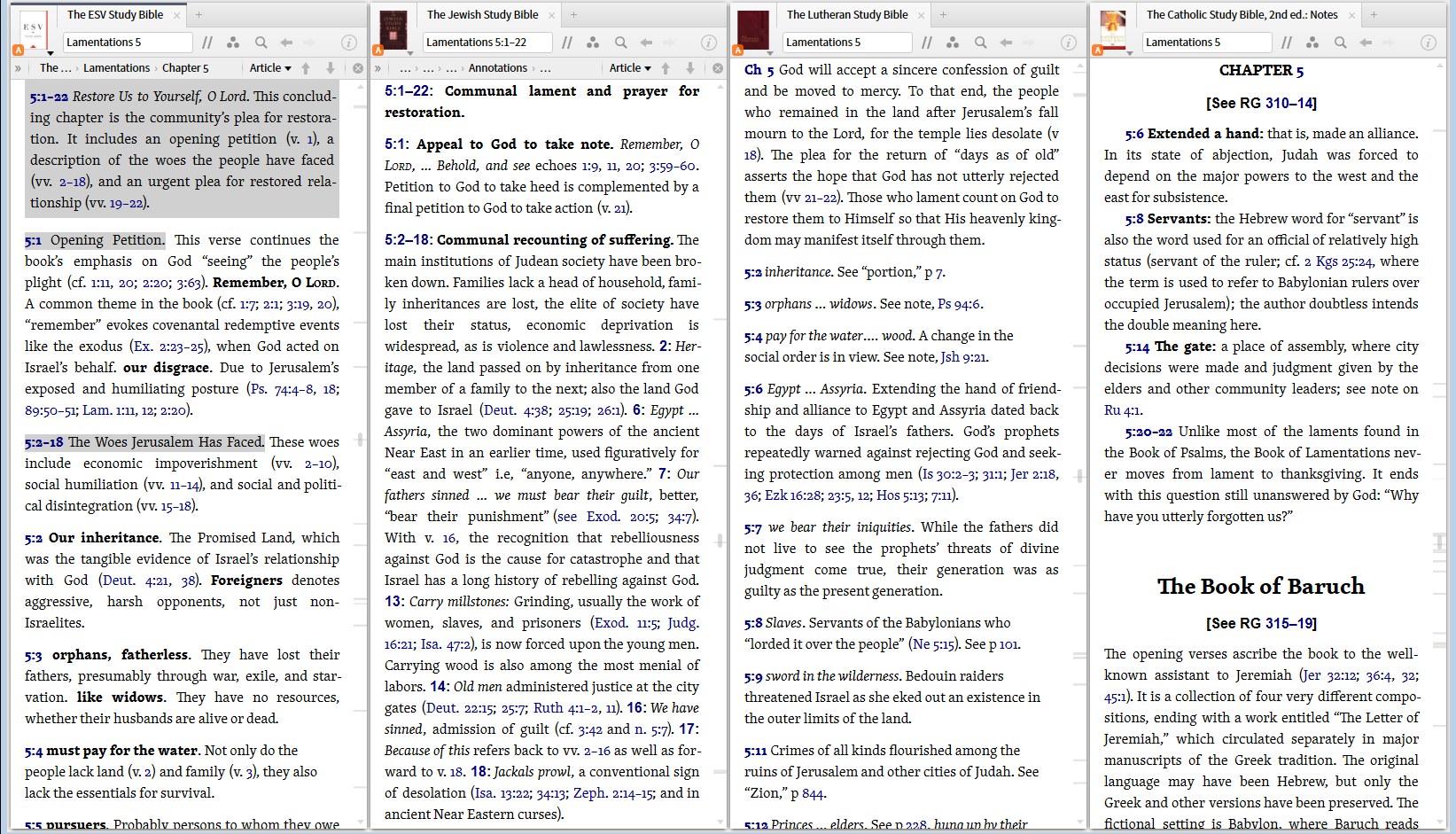
Looking at the Study Bibles beside each other, I can make the case for the Complete Word Study Bible being Bible and Catholic Study Bible being Commentary but I don't see how the Jewish Study Bible is not Bible Notes - it is more like the ESV Study Bible than the Catholic Study Bible.
Complete Word Study Bible is definitely a Bible. From that screenshot the others are all Notes to me, esp. Catholic Study Bible. I just wish FL would stick with the notion that if it's called a "Study Bible" then it's not intended as a Commentary (Bible Notes are also included with Bible Commentaries in PG!). But the actual assignment matters little in the end as I just tag unworthy commentaries as Notes.
But the actual assignment matters little in the end as I just tag unworthy commentaries as Notes.
Now that's a loaded statement - and a bit unfair as they serve very different purposes for quite different markets. It's like complaining a dairy cow doesn't produce well-marbled steaks.
This discussion has been held before: https://community.logos.com/forums/t/23061.aspx As the Morris Proctor description link is no longer live, I suggest that Logos needs to weigh in.
The New Unger's Bible Handbook also seems oddly classified as Bible Notes - while looking more like a commentary in structure.
Now that's a loaded statement
That the "assignment matters little in the end" is my way of walking away from the conflict because it can be handled in my environment.
If the "Dairy cow" / "steak cow" analogue refers to an unworthy milk cow being relegated to the steak market then I refer you to my statement of "purpose" as defined by the publisher/author (or farmer[:)]).
The New Unger's Bible Handbook also seems oddly classified as Bible Notes
Any book that covers 1 Sam 5:6 - 6:21 in four lines or 9:1 - 10:16 in three lines is note taking! The NT isn't any better e.g. Rom 2:1-16, 2:17- 3:8
Now that's a loaded statement That the "assignment matters little in the end" is my way of walking away from the conflict because it can be handled in my environment. If the "Dairy cow" / "steak cow" analogue refers to an unworthy milk cow being relegated to the steak market then I refer you to my statement of "purpose" as defined by the publisher/author (or farmer). The New Unger's Bible Handbook also seems oddly classified as Bible Notes Any book that covers 1 Sam 5:6 - 6:21 in four lines or 9:1 - 10:16 in three lines is note taking! The NT isn't any better e.g. Rom 2:1-16, 2:17- 3:8
If the "Dairy cow" / "steak cow" analogue refers to an unworthy milk cow being relegated to the steak market then I refer you to my statement of "purpose" as defined by the publisher/author (or farmer).
And to me this interaction helps clarify our own internal dilemma. It sounds similar to ones we have in the office. Thanks for posting the link to the other thread, I'll take a look there.
I appreciate the insights.
Available Now
Build your biblical library with a new trusted commentary or resource every month. Yours to keep forever.