See my great search on person:Jesus verb-lemma:ἀκολουθέω !
I was studying Mat 19.22 where Jesus asks the young ruler to follow him. I thought this would be a good clause search:
person:Jesus verb-lemma:ἀκολουθέω
The results include Jesus referred to as Him to those that followed The Lamb in Revelation. Here is a screen shot of the verse and analysis views. This feature alone is worth at least the minimal upgrade to L5 and running it on a Mac is truly a joy.

Note how sorting the analysis view by Subject identifies those following.

How do I check apparent errors in coding that result in bad search results?
As others have noted, this is a mistake in the annotation, specifically on the verb "made". The best way to see directly how something is annotated is to use the context menu or the Information panel.

I wondered about this feature when I saw it. Don't get me wrong, I love my Logos, and have sold many copies. However in my old age, I getting more skeptical.
The value of this is PROBABLY completely contingent on the SCHOLARLLY talent of those doing the tagging, and their theological bent, (liberal or reformed).
So the integrity of the tagging will probably have to be "Berean'ed"
I'd agree that the quality of the annotation is dependent on the skill of the annotator, and by all means you should "Berean" it. However, we've tried our best to keep theology out of things like the referent data (which clause search uses): these are primarily linguistic facts, not theological ones (within our focus on our customer base). Whether it's "devout men" (the correct analysis) or Paul (as we incorrectly annotated this case) is a decision most informed readers of the text ought to be able to make, regardless of their theological perspective.
What is the difference between the "root:φοβος@NASM" and "root:φοβος"?
root:φοβος@NASM will find only the places where the root φοβος is being used in the text as accusative, singular, and masculine. root:φοβος will find when the text has any inflection of φοβος present. That could mean (potentially) as nomative, accusative, genitive, dative, singular, plural, and/or masculine/neuter/feminine.
So, basically, you get the root when it's the exact same form as in the ESV in that verse vs. anywhere in the ESV in any form.
. . .

Look at my screen shot, I think it will make it more clear. When you search with the @NASM you only get the instances in the ESV where the noun comes in the accusative case, in the masculine gender, and the single number. When you search without the NASM you get places where the noun appears as multiple cases including the vocative, nominative, accusative, genitive, and dative, and when it is both singular and plural. Adding @NASM just makes your search more narrow.
. . .
Here's an analogy that might be helpful. Let's say you have a book on baseball and it was in Logos. You see the sentence "Joshua hit the ball." You right clicked and looked for all the places for Joshua - the search might look like: root:Joshua.
Let's say theres three sentences with in the whole book about Joshua:
1. Joshua hit the ball.
2. The ball his Joshua.
3. In the middle of the game, Joshua fouled out.
Searching for root:Joshua would find all three example.
But lets say you searched for root:Joshua@NN (so noun and nominative which represents the subject of the sentence). The results would pull up sentence #1 and #3 but not #2. Joshua is not the subject of sentence #2 - the ball is the subject of the sentence.
When you searched for root:φοβος it was like the first search for Joshua. Your results had every place in the ESV that the word φοβος appeared no matter how it was being used in the sentence. When you searched for root:φοβος@NASM, however, you were only find places where the word was used as a noun, in the accusative, in the singular number, and the masculine gender. For simplicity sake, root:φοβος@NASM was going to return results when φοβος was the direct object of the sentence. Any other time φοβος was used was not going to show up. So root:φοβος@NASM';s results were also in root:φοβος but not all of the results from root:φοβος were in root:φοβος@NASM.
Why does my search fail - Bible vs. clause search?
Using verb-lemma:μακάριος does not find all instances of the lemma μακάριος in the LSGNT. A sample is shown below. A lemma search using the normal Bible Search tool finds all of them.

Above you can see only three of the nine times the verb μακάριος appears in Matthew 5:1-11 appear.
. . .
Rick pointed out a part of the issue here: I tried to use μακάριοςas a verb, which it is not. That doesn't explain why the clause search return a portion of the uses in Matthew 5, but only a portion. The SBLGNT Clausal Outlines look like they treat each of the uses of this word in the same way (logical) but the clausal search does not.
Perhaps I'm just not fully understanding this tool, but why does it leave other passages out that use blessed as well, such as Rev1:3?
How are you searching? A verbal search should not work, as it is an adjective, and is used as a predicative nominative in that verse.
In Rev 1:3, the verb-less clause whose predicate is the adjective μακάριος (blessed) is omitted because our analysis didn't determine any semantic arguments of the clause. Ideally, it would have determined that the semantic referent of the (long) subject phrase (translated "the one who reads aloud the words of this prophecy, and those who hear, and keep what is written in it") was the same "Person in Revelation" referred to by its sub-phrases.
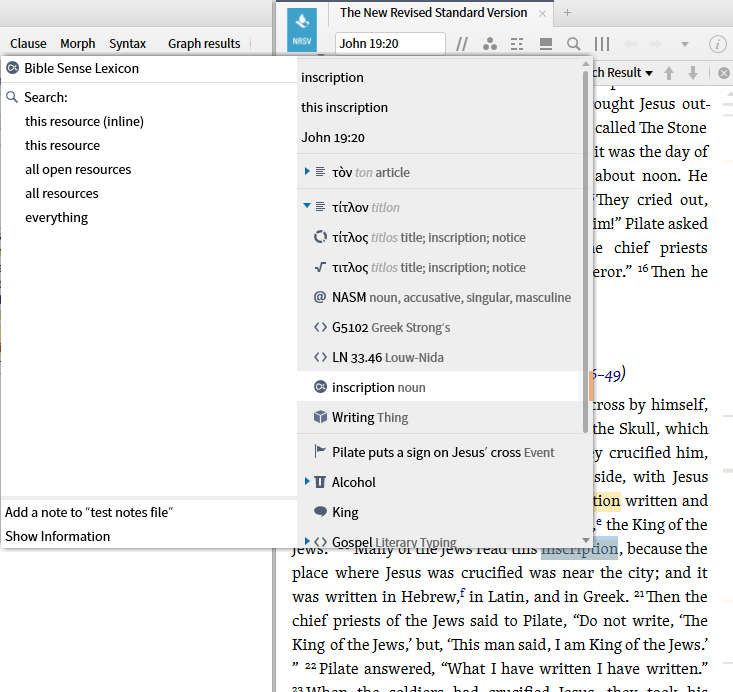
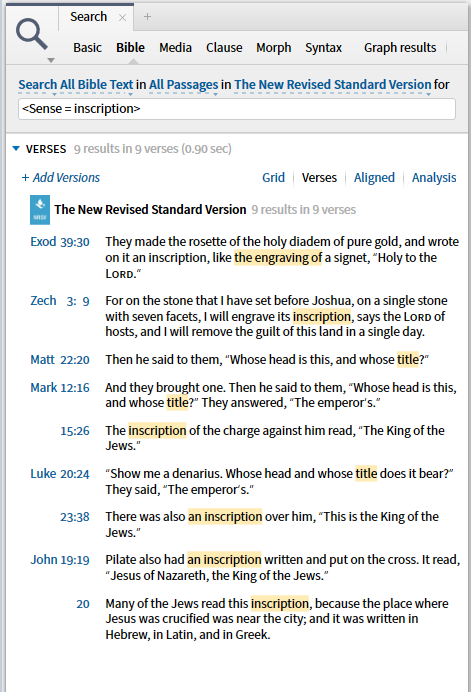
Is there a way to see all instances of that particular "sense" in scripture?
Use the datatype <sense>
How do I explain my results for lemma:μακάριος and restrict the search to the gospels?
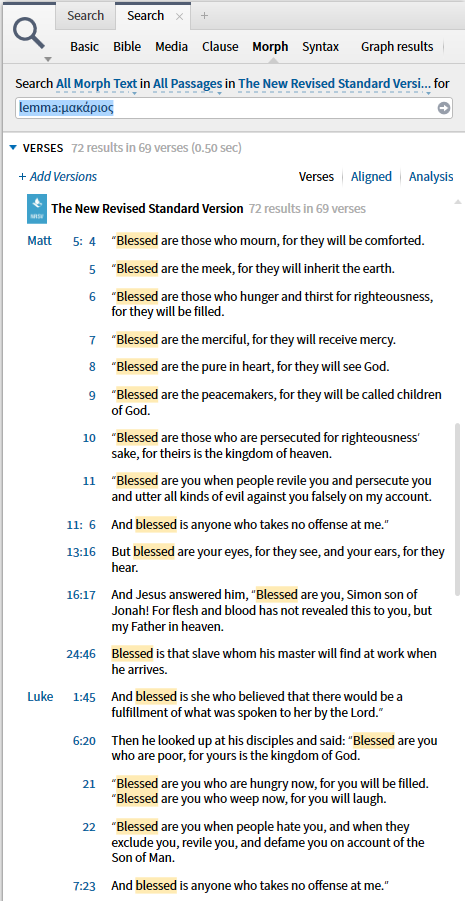
One thing you could do is search for the verb-lemma:μακάριος and restrict your search to the gospels. However in doing that I find an anomaly which is probably a bug, in that not all occurrences of the Greek word μακάριος show up.
I wouldn't expect all occurrences of μακαριος to show up as "verb-lemma" because it is an adjective. In clauses like the Beatitudes, however, Cascadia treats the "blessed" phrases as verbless clauses with μακαριος as predicator.

Because it functions that way, and because Cascadia has annotated it this way, as the source of the predication, it ends up in the verb-lemma portion of the clause search even though it is not a verb. In this case, Cascadia's analysis marks "the meek" as the subject; "The meek are blessed because they will inherit the earth"
. . .
It is (relatively) common for something that is specified as subject in the Greek to be translated as an object in the English. The results all seem to have Jesus as subject in the Greek.
Luke 1.42 could literally be translated in English as "the fruit of your womb [is] blessed"; the translation just follows the Greek order — but "the fruit of your womb" is in the nominative, and it is the subject; it is in apposition to the nominative participle.
Luke 24:51 is an infinitive, which routinely takes the accusative as subject, thus "He blessed them" even though the pronoun "he" is in the accusative.
Jn 12.13 is similar in structure to Lk 1.42; a participle with nominative phrase in apposition.
How would I do a search for Jesus everytime he claims "I Am"?
Search for "I Am" with Match Case selected as certain bibles emphasise the Greek that way.
I would use the words-of-christ fields in a Bible search. Unfortunately, that only works for English searches, which is not ideal for this sort of thing. However, a Top Bibles search for the following should work:
(words-of-christ:I ANDEQUALS <lemma = lbs/el/ἐγώ>) WITHIN 1 WORD (words-of-christ:am ANDEQUALS <lemma ~ lbs/el/εἰμί>)

Why can't I find Jesus in the Old Testament using a clause search?
I think it best to realize that the clause search is a biblical search tool that can search for persons when the person's name is not in the biblical text. Jesus would be referred to as "He said" or "Him" etc. Since Jesus is not in the OT except in the prophetic sense you cannot search for the Person:Jesus there. Regarding Isaiah 53:5, try using the clause search in the NT for Person:Jesus and limit your search to 1 Peter. You will find that the parallel OT in the NT for the Isaiah passage is included as referring to Him, ie Jesus. So where the OT is quoted as a reference to Jesus the Clause search will pick it up.
Since it is a tool that is based just on the text of the Bible, not our understanding of the Bible, it cannot find things like you expected. It is a very powerful tool, just the same. It will allow you to find all the times Jesus is referred to in the Bible where the original text actually refers to him either with his name, one of his titles, or just with a pronoun. That will restrict the results to the NT since that is the only place where the text contains direct references to him.
I think the Isaiah 53 quote is an interesting example of how the Clause search handles this. I went and looked at the tagging in the Lexham Hebrew Bible. It tags the "He" as the Pierced Servant. The tagging doesn't answer the question of who this servant is, that's the role of theology and interpretation to make clear. Now, in this case I imagine that a significant portion of Christians (a majority?), in light of the way 1 Peter quotes this, understand Isaiah to be referring to Jesus.However, I can think of a number of hermeneutical strategies that would place doubt on that conclusion. I'm not endorsing any particular understanding with this observation.
I guess what I'm trying to say is that I like this strategy because the less interpretation in the tagging, the more useful it is to people of differing opinions and hermeneutics.

How would I do a SYNTAX SEARCH for the SUBJECT of all occurrences of ברא bara = to create in the Anderson-Forbes Phrase Marker Analysis resource?
It's easier to do a Bible Word Study, and use the Grammatical Relationships section. Or you can do a clause search in the Lexham Hebrew Bible, and switch to Analysis view to see subjects and objects.
Unordered allows Clause IC 1 and 2 to occur in any order (and with variable separation). Type ברא as the lexeme and choose the verb

How do I specify a specific lexicon sense (homograph number) of a lemma in a search?
Because I don't know Greek or Hebrew I take the long route.

That 1 in the BWS is from the Lexicon, which contains multiple definitions of the word. It is not a sense #.

The ability to search cases where a particular sense occurs (regardless of lemma) is a key feature of Bible Sense Lexicon. This "sense concordance" capability is definitely coming soon, so don't lose hope!
Until there, here's the best workaround i can suggest:
- Start with BWS on a word like "grace"
- Pick a lemma in the word wheel, like "χάρις" and select it. Now you'll see a concordance below, and the lemma itself is a link to BWS on that lemma.
- From there you can click on the reference for a verse of interest, and then use the interlinear ribbon to see which sense is used
- Or, you can look at BWS on that lemma and see the different senses (7 for "χάρις")
You can also type lemmas into the search box for BSL (including strings like "g:charis") and the dropdown will show you all the available senses that lemma expresses.