How do I create a link set with a primary resource that controls the set?
in a Link Set scrolling any resource will cause the others to scroll as well.
If you set a panel up to show multiple resources (a Logos Now feature) then scrolling the first resource will scroll the others but scrolling any other resources will leave the others unchanged.
the behavior you see is normal due to the bi-directional manner how linked sets work.
Can someone help me find a Way that the Linked Recources just change, if i scroll my Bible?
You'd need to use the new Multiple Resources tabs, which employ a primary resource associated with secondary resources that scroll with the primary (which typically would be a bible).
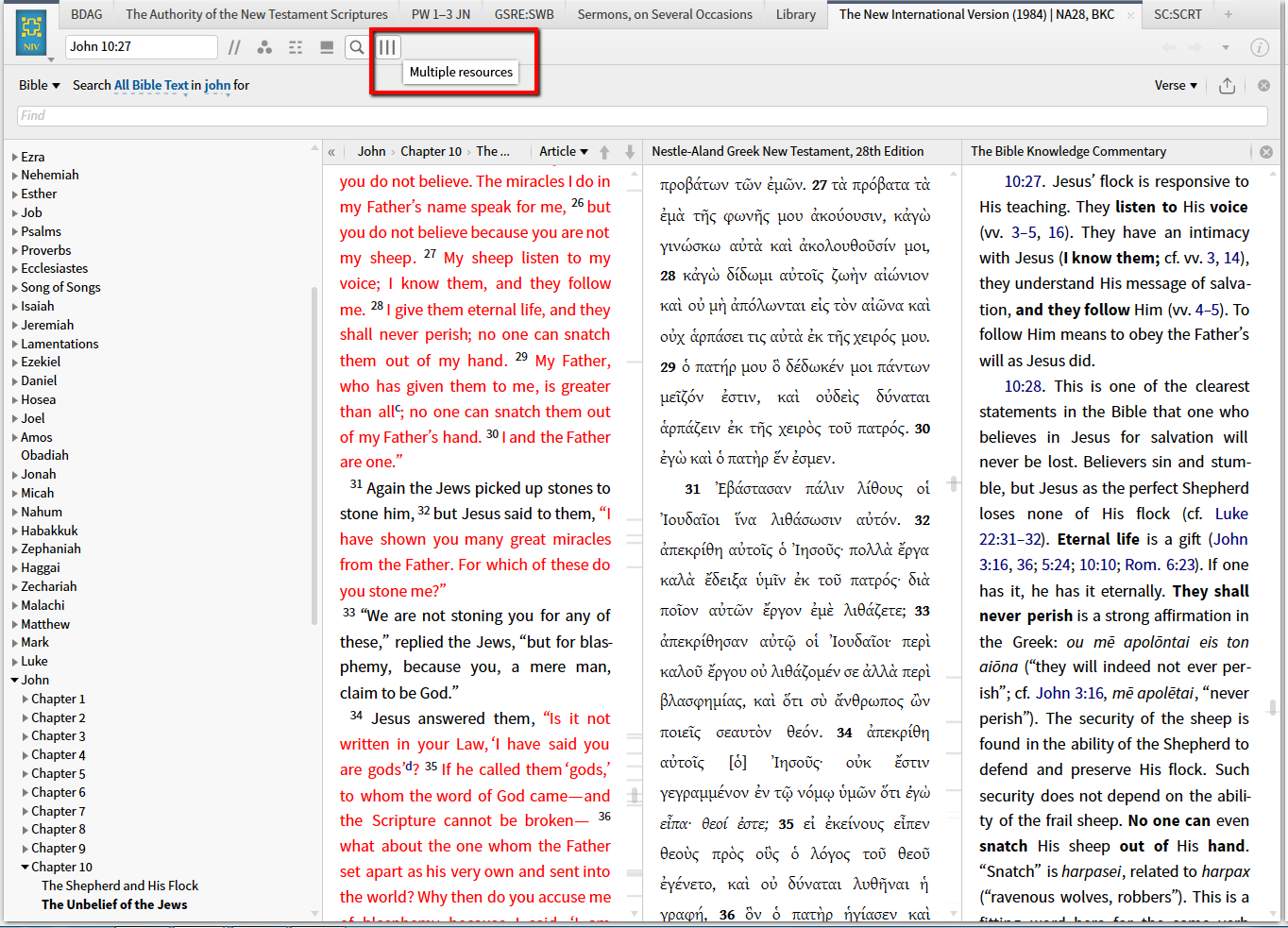
AFAIK This is a Logos Now feature.
How do I view a timeline of the Prophets and Kings of Israel/Judah only?
You can add or subtract information that appears in the timeline using the Fit, Subject, and Type drop downs. Fit enables you to show a specific era. Though if you do not see the time frame you are looking for, you can type it in manually. Subject limits the timeline to a specific subject matter and Type enables you to select the type of information you want to see as it relates to the subject within a selected time frame.
Printing and Exporting all of the data can be an issue because Logos exports or prints an image of the timeline.
You may find this video helpful
https://www.logos.com/logos-pro/timeline
Where do lemmas that are used as attachment points (in notes) show up?
They curretntly only appear in original language texts such as NA27 or LHB
What is the Best greek Septuaginta to work with Logos?
The Gottingen Septuagint if you want a critical edition.
The Logos Septuagint with you want morphology and the ability to compare with the Hebrew text, or Swete's if you can't afford it. The Logos Septuagint is is based on Rahlf's, which is considered a better text that either Swete's or Brenton's.
The Lexham Greek-English Interlinear (Rahlf's) if you want an interlinear (or Swete's if your budget is tight).
Brenton's if you can't afford anything else (it has no Hebrew morphology).
"Best" is of course subject to your study needs (and budget).
The Reading List of Greek Bible Text Resources in Logos gives you the options in Section 4 (note that Brenton's unmorphed text is not listed here but as a Vaticanus edition under Section 2 "Codexes"):

If you want to go back and forth between Hebrew, Greek and English, you may even want two: Logos LXX with Hebrew RI and LXX Interlinear:

For anyone else passing thru:
- Gottingen is heavy-duty and not yet complete. Read greek? Need to. And given the price, you'd do well to research the other choices outside Logos.
- Logos Septuagint is necessary for a host of Logos lemma studies. However the displayed morphs are the hebrew. You'll need the LXX interlinear(s) for displayed greek morphs. Additionally there's no english glosses.
- The SESB (several groupings) provides the quickest access to LXX critical apparatus that hits the highpoints. If you get both the hebrew and LXX, you get two decent apparatus resources (plus the WIVU intro).
Though note that Swete's does have an apparatus as well. It will cover variations with the major uncial/majuscule LXX manuscripts.
Difference between Swete and Rahlfs:
- Swete is a Diplomatic edition; it is a transcription of what Swete determined to be the best manuscripts at the book level. He fills in major holes/lacunae with the next-best manuscript. He typically goes with Vaticanus, then Sinaiticus, and from there it's whatever he determines based on what's available for the hole (So Genesis is a bit of a patchwork).
- Rahlfs and Göttingen are Eclectic editions. Editors attempt to determine the best available reading for a textual unit. Rahlfs' apparatus deals with many of the major uncial/majuscule MSS as well.
How do I search for God's presence?
Does <person God> NEAR presence get you what you want?
Similar search:
<Person God> NEAR <Sense presence>
has different results to consider:
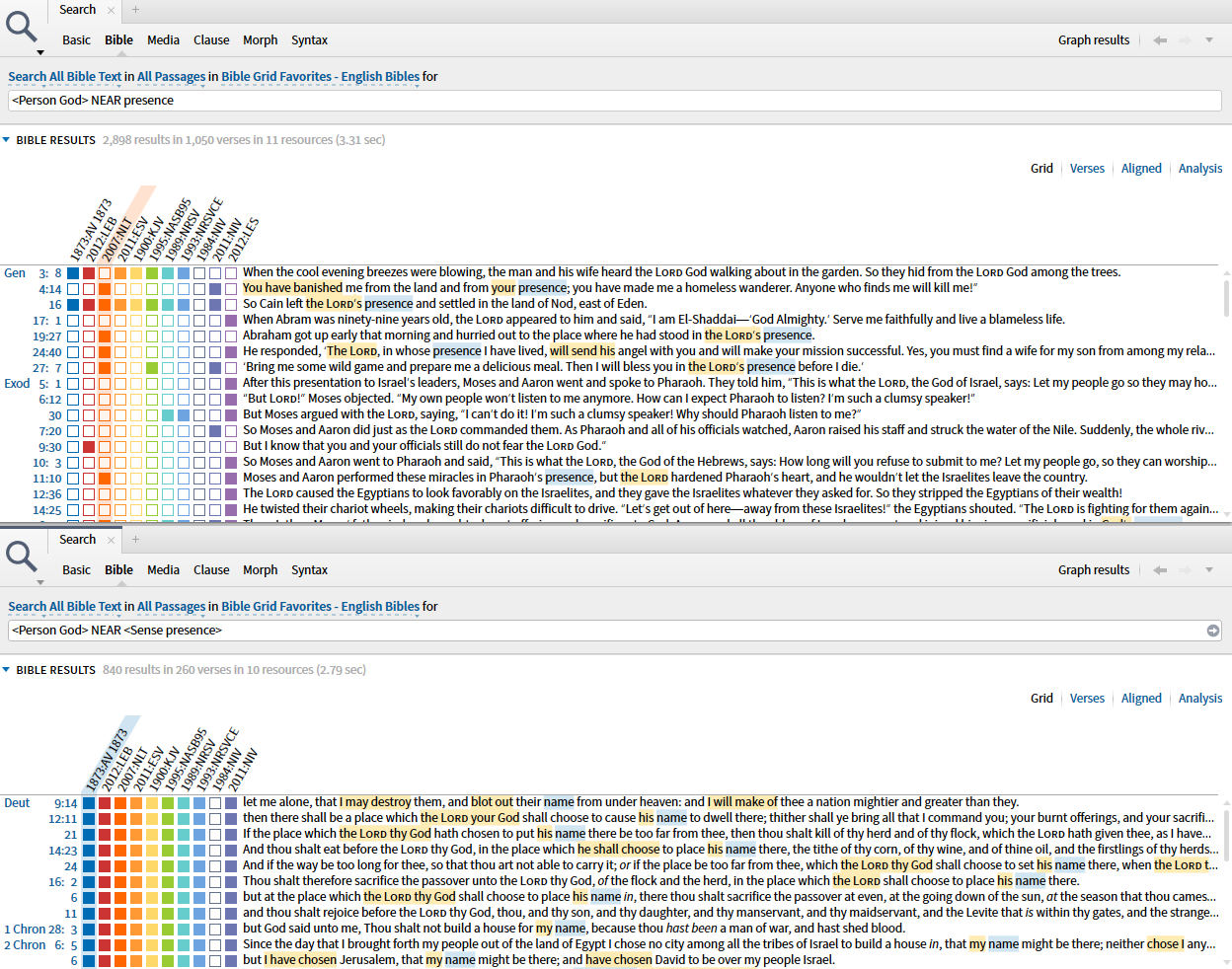
What is this line in the search results?
question:

It's the eqivalent to "more", or the thread pages in the forum software - the search results are displayed in chunks, ordered by bible reference, and the line allows to jump to other chunks starting with the respective verse.
Tags vs. Labels — What are they used for? What's the difference?
Simplified:
Labels are a way of adding metadata /classifications to resources e.g. Faithlife uses Labels for journal articles to add author, title, Bible references or Labels for sermons to a author, occasion, title, Bible references ... You might use them to identify parables and add speaker, topic, ... or to provide your own classification for psalms etc.
Tags are a way of adding metadata / classifications to your notes and clippings.
Community tags in resources are a way to add Biblical entity tags to resources where Faithlife has not tagged them.
How do I make a list of quotes Jesus made from Deuteronomy?
If you have Logos Now you can use:
{Speaker <Person Jesus>} WITHIN {Label Intertext WHERE Source ~ <Deuteronomy>}

That includes allusions to Deuteronomy. If you just want exact quotes it's:
{Speaker <Person Jesus>} WITHIN ({Label Intertext WHERE Source ~ <Deuteronomy> AND Relationship="Quotation"}, {Label Intertext WHERE Source ~ <Deuteronomy> AND Relationship="Citation"})

The reference in 1 Timothy is showing up incorrectly because the first expression comes from Deuteronomy 25:4, whilst the second expression is something Jesus said in Luke 10:7. The Intertext labels apply to whole verses, not specific phrases.
[quote]
I don't have Logos Now
Then you need multiple steps, and a little more work:
- Run a Bible search for {Speaker <Person Jesus>}.
- Save the search as a Passage List.
- Open the resource Old Testament Quotations and Allusions in the New Testament.
- On the Visual Filters menu, select the Passage List you saved in step 2.
- Move to the Deuteronomy section of the resource.

it seems you utilize the very helpful "Filter by Passage List" feature here - which again, if I'm not mistaken, is part of Logos Now
a merge of passage lists solve the problem ... just the union of the 2 lists
The best I can do would be:
- Using Print/Export, copy the whole Deuteronomy section of Old Testament Quotations and Allusions in the New Testament to the clipboard.
- Create a new Passage List called something like Deuteronomy in the NT, and add to it from the clipboard.
- Optional: Sort the Passage List into Canonical order, and delete the passages outside the NT. (To do so, click on the first unwanted entry e.g. Deut 1:10, then SHIFT+click on the last unwanted entry, e.g. Deut 33:12. Then press DELETE.)
- In a Bible search, change "All Passages" to the Passage List you just created. For the search itself, use {Speaker <Person Jesus>}.
- When viewing search results, use a linkset to Old Testament Quotations to see the Deuteronic context.
Possibly the biggest problem with this method is that it includes Allusions, not just Quotations. You can filter to just OT Quotations using {Speaker <Person Jesus>} WITHIN {Section <LiteraryTyping ~ Quotation, Old Testament>}, but if you do, you miss some results.

It has only 15 results. The first method I showed you had 22. Matt 4:7, 5:31, Mark 7:10, 10:19, Luke 4:12, 18:20 are missing, mostly probably due to a search bug. Also missing - probably because there's a question as to whether it's a quote or an allusion - is Matt 18:16 and John 8:17.
Please explain my BWS results.
Question:
[quote]
I was performing a Bible Word Study on Hesed and noticed that Logos breaks some occurrences as "steadfast love" (11) in the ESV while the majority it lists simply as "love" (187). It would appear to me that the majority of these 198 uses should be listed together as "steadfast love", with maybe Job 37:13 and Hosea 6:4 being categorized as "love" and Isaiah 55:3 being recorded as "sure love" or possibly as "steadfast, sure love".
The point is to see how one particular word in the original language is translated into English, correct? If that is the case, then I do not understand the separation here.
.jpg)
.jpg)
Answer:
I think it's a tagging issue.
Looking at Gen 24 the phrase "steadfast love" appears in both verses 12 & 14 but only one (v14) is shown as translated in this way in BWS
Clicking on each of them and looking at the reverse-interlinear ribbon shows different shading in each case. One has two shades of blue while the other just has one.


I believe this is significant and know it was discussed some time ago but I forget the details.
How do I find locked resources in Lexham Bible Guides?
If you are a Logos Now subscriber, you could run the Concordance on LBG Genesis, set the view to "Works Cited" and browse through the list of titles. Look for the padlock icon to see works we have in Logos that you don't own. Sorting by "Count" will show the most cited works at the top of the list.
What Happened to Sympathetic Highlighting option under Visual Filters?
It's been renamed "Corresponding Selection"
See bottom of this page: https://wiki.logos.com/Logos_6.8
How do I search journal articles by author?
- Create a collection of your journals, i.e. type:journal.
If collections are new, see https://wiki.logos.com/Collections
- Start a Basic search in your "Journals" collection (or whatever you called it).
- Instead of searching "all text", use the search field "author".
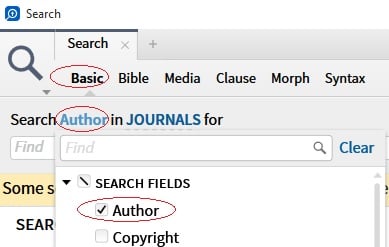
Note that some of the older journals may not have been undated so as to mark the author to match this search. But this finds the articles where the author has been marked.
Or you could simply do what HELP suggests:
{Label Journal Article WHERE Author ~ "whomever"}
Thanks for your addition here, MJ. I was curious to see if the author field and the new labeled data for journal articles were running on the same dataset. So I ran a couple searches to check. It appears that they are not from two searches I ran of the same collection. Here is the first on the name "keller."
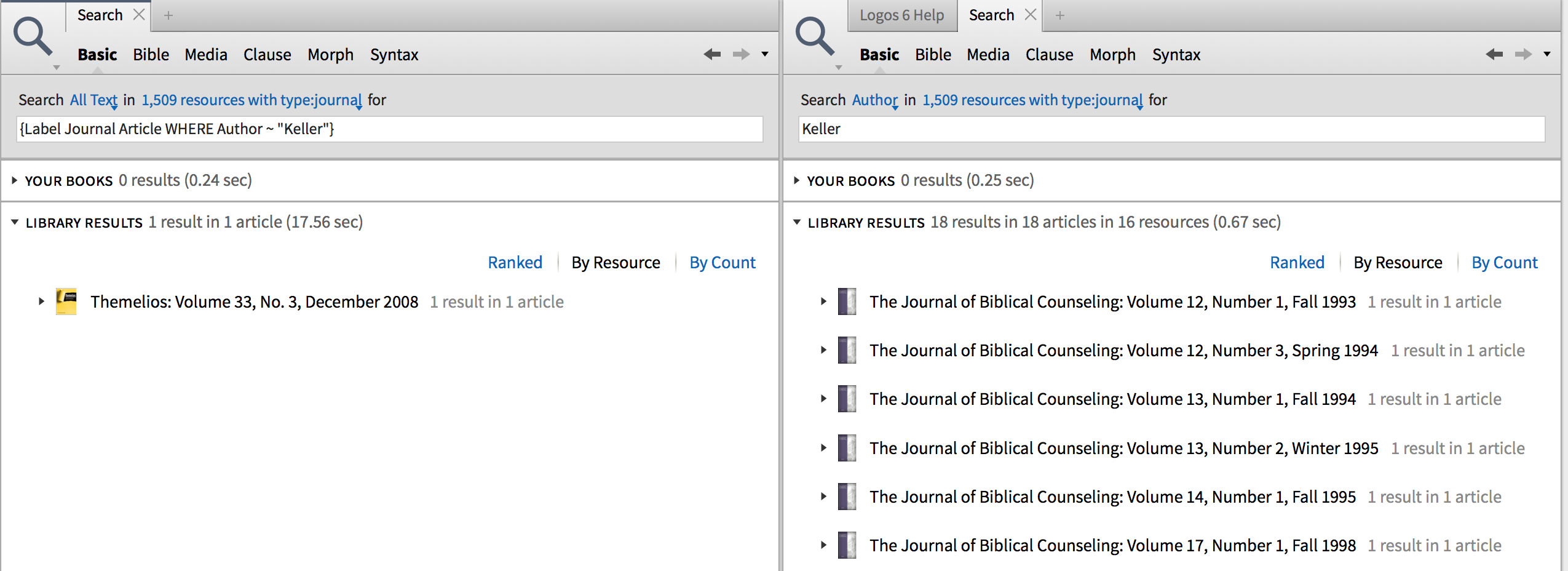
Here is the same search using the name "carson."
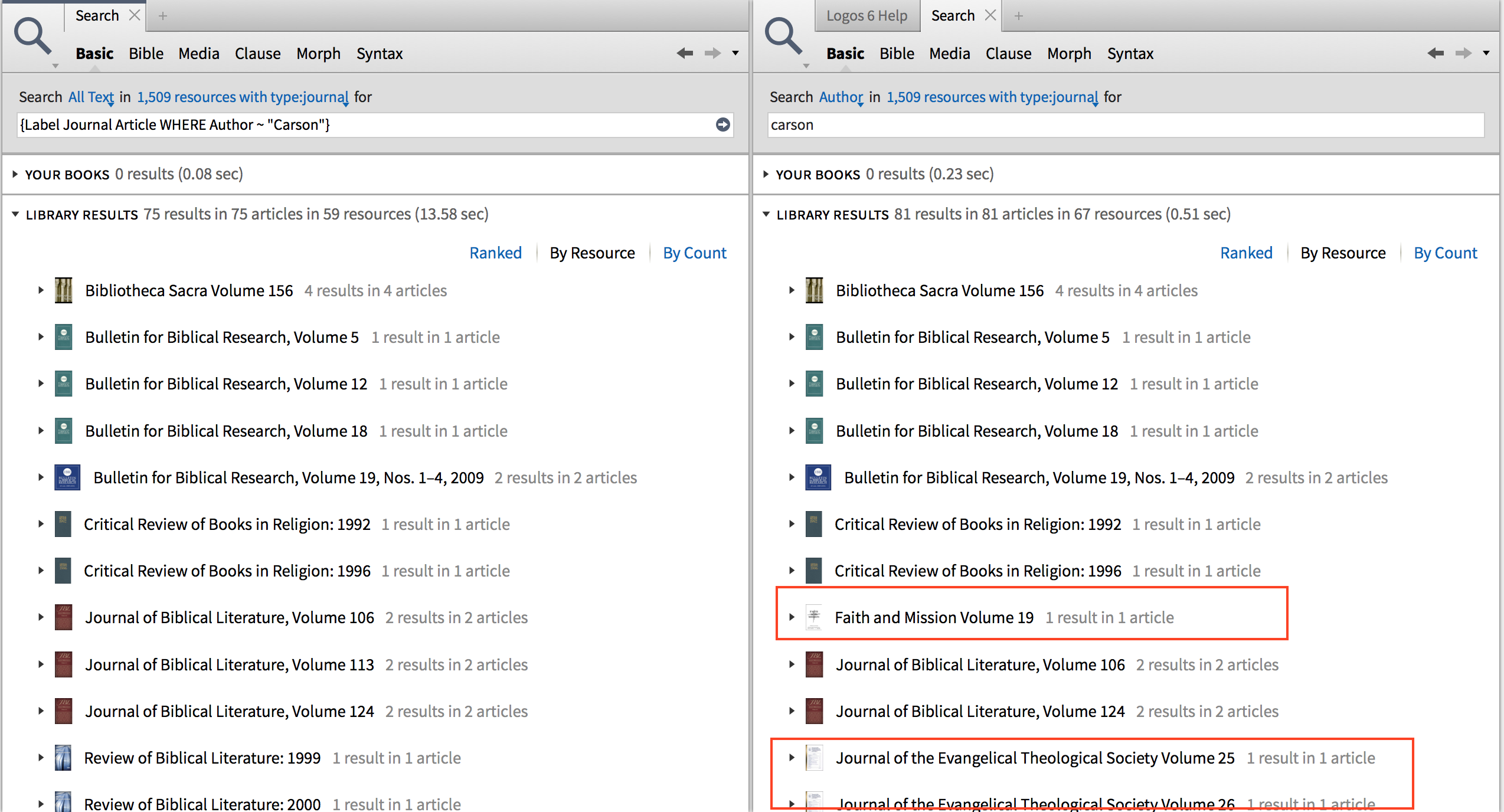
I highlighted the difference here in the second query. My thought is that the field search is a separate dataset that is older and more comprehensive in nature than the newer searchable labels. Older journals that have not been included in the new journal collections (e.g. JETS and Faith & Mission) appear to not be included in the newer labeled data set. I found this very interesting, and thought I should share as an FYI.
I was thinking along the same lines. To capture both, the search string would need to be:
{Label Journal Article WHERE Author ~ "whomever"} OR author:whomever
Can I search for what Jesus says about himself?
It rather depends on what you mean by "says about himself". I'd be inclined to start with:
<Person Jesus> WITHIN {Speaker <Person Jesus>}

You could remove indicatives with (<Person Jesus> NOTEQUALS <LogosMorphGr ~ V??I????>) WITHIN {Speaker <Person Jesus>}, but you might lose more than you want.