If one were to rely on Factbook, you might assume that Logos knows little about Performance Criticism. (To be a bit snarky, this is a bit more than it knows of most of the advocacy or ideological criticisms.
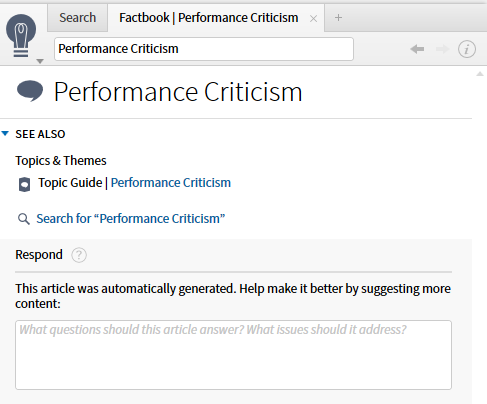
However, Logos carries several resources that are informed by performance criticism:
- Brickle, Jeffrey E. Aural Design and Coherence in the Prologue of First John. Edited by Michael Labahn. European Studies on Christian Origins. London; New York: t&t clark, 2012.
- Hearon, Holly E., and Philip Ruge-Jones, eds. The Bible in Ancient and Modern Media: Story and Performance. Biblical Performance Criticism. Eugene, OR: Cascade Books, 2009.
- Maxey, James A. From Orality to Orality: A New Paradigm for Contextual Translation of the Bible. Vol. 2. Biblical Performance Criticism. Eugene, OR: Cascade Books, 2009.
- Wire, Antoinette Clark. The Case for Mark Composed in Performance. Vol. 3. Biblical Performance Criticism. Eugene, OR: Cascade Books, 2011.
- Miller, Robert D., II. Oral Tradition in Ancient Israel. Vol. 4. Biblical Performance Criticism. Eugene, OR: Cascade Books, 2011.
- Horsley, Richard A.and Thatcher, Tom. John, Jesus and the Renewal of Israel
A basic understanding of the intent of performance criticism can be obtained from Performance Criticism: An Emerging Methodology in Biblical Studies by David Rhoads, Lutheran School of Theology at Chicago:
[quote]
Summary: This paper argues for the centrality of performance in the life of the early church, appoint that traditional scholarship has not addressed. In light of some emerging trends, it proposes that we establish “performance criticism” as a discrete discipline to analyze the performance event as the site of interpretation, including the dynamics of performance, the influence of place and circumstance, and the experience of an audience. Performance criticism could draw upon resources from many disciplines of biblical scholarship : historical criticism, narrative criticism, reader-response criticism, rhetorical criticism, orality criticism, social science criticism, speech-act theory, discourse analysis, and ideological criticism. In turn, performance criticism has the potential to transform all these methodologies in fresh ways. Performance criticism could also draw upon the modern fields of oral interpretation of literature and theater studies. A discipline of performance criticis m would enable us to construct performance scenarios of the early church. Equally important, it would inform our understanding of the meaning and rhetoric of the New Testament writings. Such a discipline might also engage the interpreter in the actual performing of texts in Greek and English. Finally, performance would breathe new life into biblical studies and into the experience of the Bible in the modern world.
In short, performance criticism represents the continuing division of the study of literary and cultural context Some examples of its application drawn from Tate, W. Randolph. Handbook for Biblical Interpretation: An Essential Guide to Methods, Terms, and Concepts. Grand Rapids, MI: Baker Academic, 2012.:
[quote]
Performance criticism can be applied in numerous ways to accomplish different ends. When applied linguistically, for example, it raises the possibility that the text of Q—a theoretical text that the SYNOPTIC GOSPELS use as a source—may have been not an actual text constructed by the wealthy or the poor but an ORAL TRADITION memorized through performance (Horsley, Oral Performance, 80). Richard Horsley uses Luke’s record of the Sermon on the Mount as an example of a memorized performance to show that memorization is more common and is embedded into the text of ancient societies. Each of Luke’s BEATITUDES replicates a series of stresses that are rhythmically easier to memorize, using a pattern of “cradling” and “lifting” (79–81). Horsley examines the nuances of KOINE Greek to suggest that synoptic authors may have been using an oral tradition in their works rather than an actual Q document. Based on historical criticism, Horsley suggests that people in the first century did not have easy access to written texts and therefore were more likely to memorize discourses or texts by using such methods. Thus, the performance critic isolates parts of biblical language to comment on the RHETORIC of the Greek text and its capacity to be memorized easily by an audience. Though replicating the sound of ancient Koine Greek seems nearly impossible, listening to any consistent replication of a dead language is beneficial for hearing recurring patterns (Daitz, 411–12). Thus, when applied to a biblical text, performance criticism suggests that the Q source may not have existed as a written text and that the Sermon on the Mount follows linguistic conventions that make it easy for an audience to memorize it.
Another valuable insight that performance criticism lends to biblical scholarship is the performance test. For example, some Markan scholars have difficulty understanding Jesus’s words to his disciples about the poor widow in Mark 12. Some interpret Jesus’s statement about her as a criticism “for contributing to a corrupt temple that is doomed to destruction” (Rhoads, 34). However, Rhoads suggests that Jesus’s line—“Truly I tell you, this poor widow has put in more than all those who are contributing to the treasury. For all of them have contributed out of their abundance; but she out of her poverty has put in everything she had, all she had to live on” (Mark 12:43–44)—cannot be performed to convey such a meaning. Additionally, Rhoads asks, “How could one convey the Jesus cry of abandonment on the cross (from Ps. 22:1) so as to express hopefulness?” (34). He concludes that a text has a range of possible meanings and possible performances, and evaluating potential performances to a modern and an imaginary ancient audience may be one way to “test the limits of legitimate interpretations” (34).
Performance criticism coupled with historical criticism of Mark has led scholars such as Richard Horsley to believe that the whole text of Mark and even other works of antiquity were originally oral tradition and meant to be performed; they were “inscribed upon the memory as much as on papyri” (Horsley, Jesus in Context, 89). Such communication characterizes ancient societies, and texts were more likely to be performed than read silently, as is modern practice (91). In ancient societies, scrolls were costly, and though some persons appeared to be literate, many were not. The interplay of power between the literate and illiterate and its relationship to auditory performance is a new development in biblical scholarship, and this element of ancient society is quickly becoming the topic of performance criticism applied to the Bible.
In "The Theory and practice of 'performance criticism': Its implications for Bible translators and their target audiences - with special reference to the wisdom discourse of James 3:13-18", Ernst R. Wendland lists features of interest to perform criticism:
The distribution and density of traces of orality still residing in the text:
- dynamic, explicitly interactive discourse
- indicators of close personal involvement
- aural signals
- ungrammaticalness
- verbal recursion
- image-based techniques
Characteristics of oral articulation and aural apprehension:
- extended chains and concentrations of formal and semantic reiteration
- (apparent) redundancy of topical or thematic content
- episodic compositional structure and paratactic syntac
- strophic segments
- customary discourse topics
- accumulations of juxtaposed concrete imagery
- reference to extralinguistic setting
- use of well-known biblical anecdotes, types ...
- frequent dramatic contrast, appeals for audience action ...
- verbal indicators of phatic connection
- familiar, explicit genre-marking
- characteristic discourse unit transitions et. al.
- memorable diction
- confessional and liturgical citations
- snatches of direct speech
- audience engaging rhetorical devices
- abundant phonological highlighting
Essentially performance criticism has many of the same concerns as discourse analysis but placed in the context of performance i.e. the orality/aurality of the text. But while a discourse analysis is tagged in Logos, the performance tagging is not ... you are on your own with labels being as close to an appropriate tool for tagging.