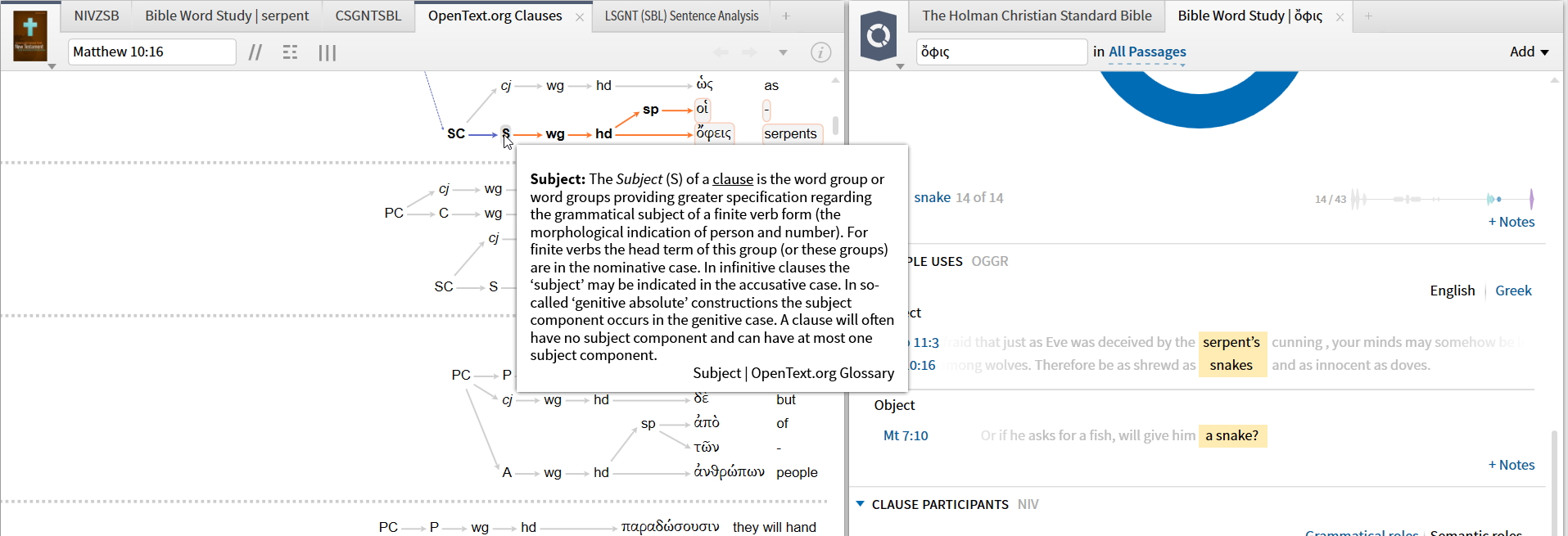
Recently have been exploring the grammatical tag feature in Logos. After running a Bible Word Study on serpent (Gk=ophis) one hit was Mt 10:16, "Behold, I am sending you out as sheep in the midst of wolves, so be wise as serpents and innocent as doves."
"Serpents" is tagged as a Subject, when actually the Subject is an understood "You" and "serpents" serve as an adverbial complement to "wise", i.e. how or the manner in which one is to be "wise", in the same way "doves" serves as complement to "innocent".
In a roundabout way you could try to make the argument that it qualifies as Subject if you have it take the place of the sentence complement "wise" which equals the understood Subject, "You". (You=wise, wise=serpent, therefore You=serpents(?)) However, that would be a stretch, and technically "serpents" is not the Subject.
If grammatical tagging has been done solely on the basis of the Nominative equalling Subject, then when one runs a clausal search to see how many times a particular Greek word serves as the Subject, the results may be skewed; though I'm guessing it may only limitedly do so in terms of numbers.
Just wanted to throw this out there for consideration. Any thoughts?
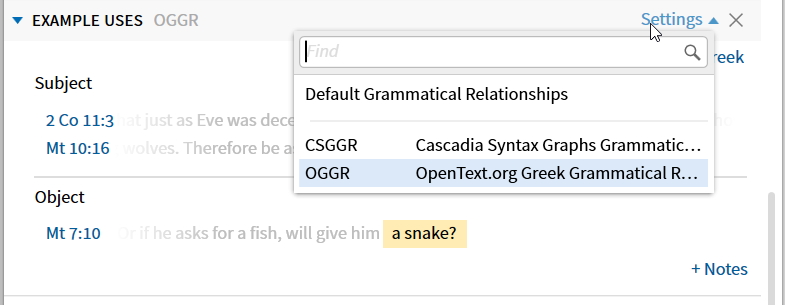
BTW, what does OGGR stand for under the Example Uses drop-down within a Bible Word Study result?
T.Drawbaugh