Faithlife will never get beyond complaints that Logos/Verbum is too hard to use until they develop the ability to read the users' minds. But that is not to say they shouldn't continue to listen to their users and look for ways to integrate the tools and resources in ways that seminarians learn in class and/or from their classmates.
Workflows are one means of integration, that works for a limited number of tasks - limited because it doesn't handle:
- non-Biblical text e.g. to study a creed or statement of faith
- multiple passages e.g. parallel passages or the assigned readings for a liturgical date
- art images e.g. visio divina, visual midrash
- invoking collections e.g. divide commentaries by date or type
One could continue but that list is sufficient to show why much of the Bible study of the "pew-warmer" (my nickname for those non-professionals who aren't in the sanctuary ... more often called "the assembly" or "the congregation") is outside the workflow capabilities. I support many of these requests:
But often, what a user wants to do is not a full workflow but simply wanting to do a single step e.g. identify major textual variants, examine all cross-references, identify Church Fathers who commented on the text, see what the text supports in doctrinal documents . . . In many of these cases, FL has identified the student need and produced a resource/tool that assists the student. However, there is a missing link -- the teacher's directing the student to the right resources for the task at hand.
I would like to suggest that Faithlife provide a wide array of layouts designed to (a) research a single issue (b) illustrate the relationships between resources and (c) illustrate the relationship between guide sections/Factbook sections and the issue at hand. These would prefer package resources to individual sources when practical; some would require a technical and a non-technical version of the layout; some layouts would be "duplicated" based on different languages and/or base texts.
The example that sent me off in this direction:
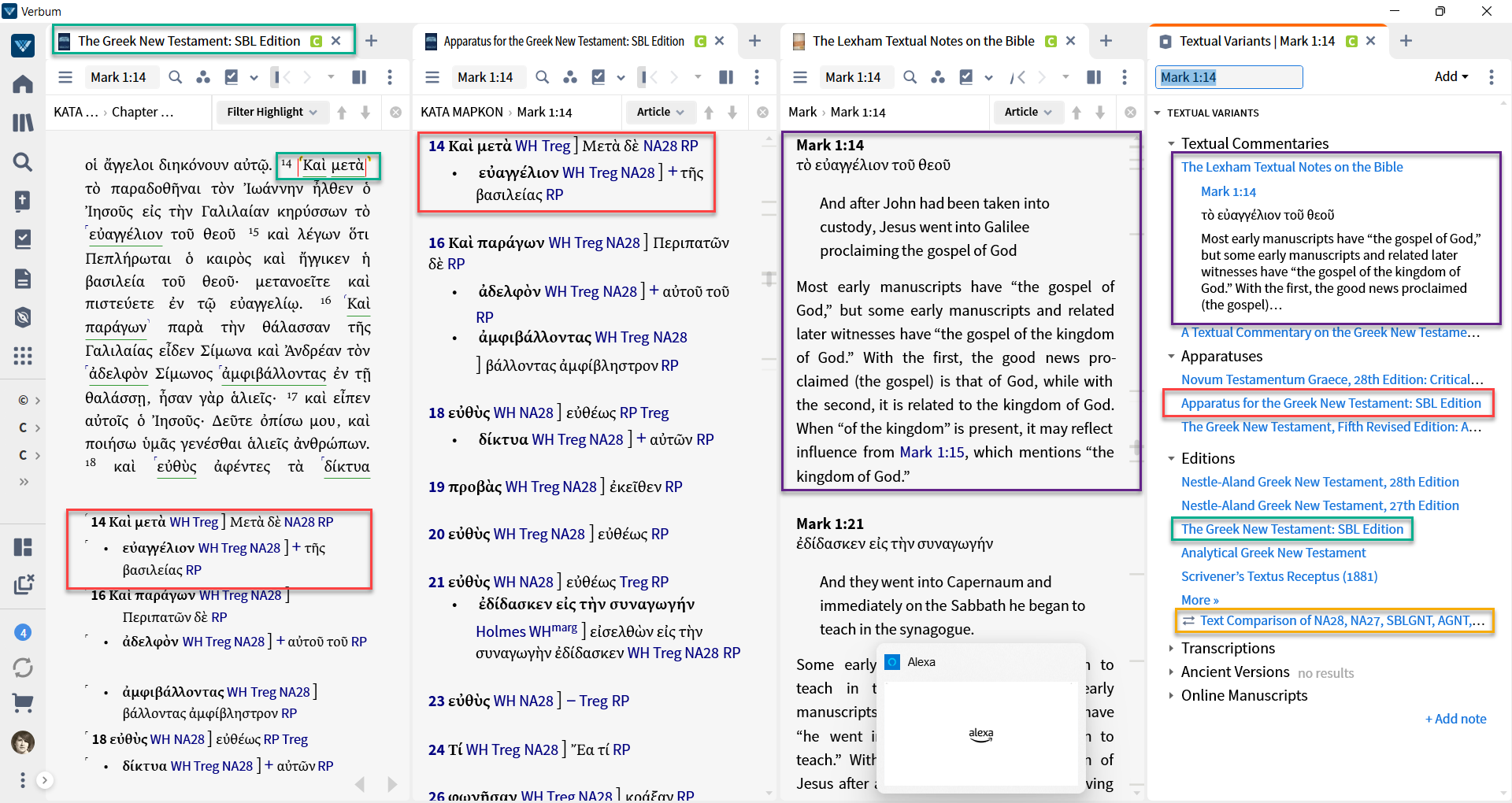
These many layouts would be modifiable with the ability to reset to the default. Potential topics:
- textual variants for passage
- Near Eastern literature related to passage
- Talmudic laws related to the passage
- Near Eastern customs related to the passage topic
- grammatical ambiguity in the passage
- variation in pericope boundaries and their effect on the interpretation of the passage
- typology that has been applied to the passage images
- Jewish vs. Christian understanding of the passage
- identification of people spoken of symbolically (primarily to prophecy)
- analysis of chiasms, parallelism, set forms . . .
- geographic locations and the folklore regarding those locations (connotation)
- where is the passage used in the service book outside of the lectionary readings?
- where is the passage used in the lectionary readings/prayer book readings? what does that apply about it's interpretation?
- various ways a person (or place) is referred to and how that helps build an image of their character
- everywhere that an event is referred to in the Bible and what that tells us about their understanding of the event
- ditto but for apocryphal/pseudepigrapha literature
- ditto but for rabbinic literature
- ditto but for Church father's writings
My list of possibilities is basically a quick brain dump. I would be very interested in what layouts you think would help you learn to integrate your resources and tools. When I think it is concrete enough to do so, I will put a formal request on Feedbear ... or not if others think it is a lame approach.