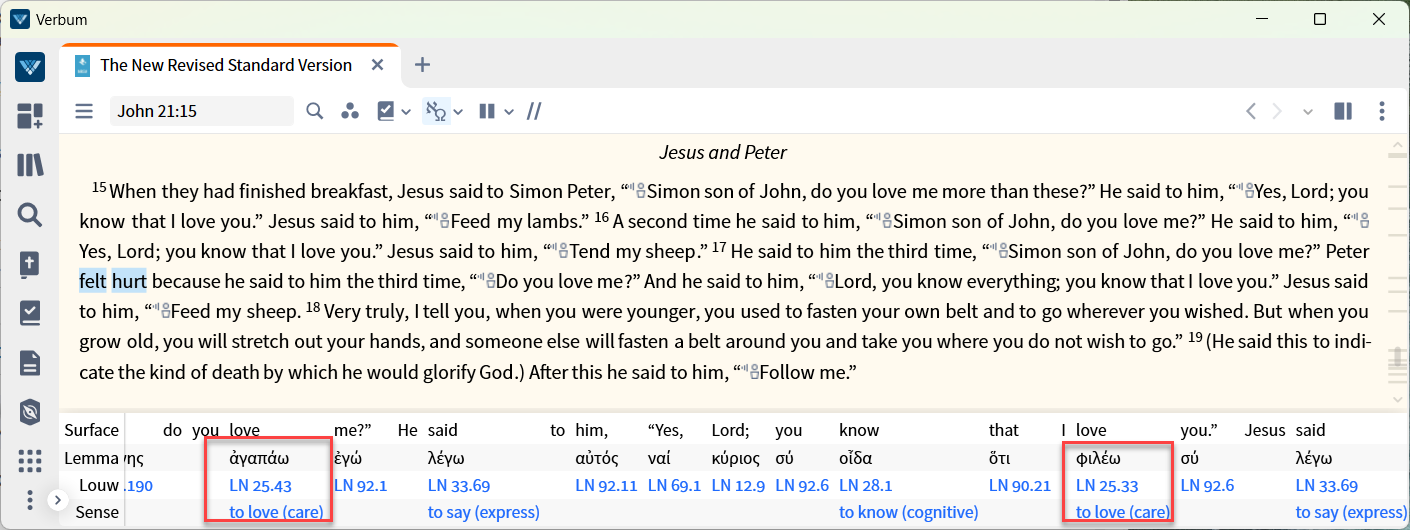
John 21:15–17 includes multiple terms for love (ἀγαπάω, φιλέω) with no discernible diference in meaning. Has this multiplicity been used for any other terms that have the same meaning as before in John 21:15-17?
John 21:15–17 includes multiple terms for love (ἀγαπάω, φιλέω) with no discernible diference in meaning
You are stating an assumption here - others suggest there are different meanings..
Has this multiplicity been used for any other terms that have the same meaning as before in John 21:15-17?
What do you mean?
I'm trying to understand the question you are asking in terms that could be used in Logos
multiple terms for love (ἀγαπάω, φιλέω) with no discernible diference in meaning.
Some lexographers argue that there always is a discernible difference in meaning even when the words are synonymous i.e. there is a context in which one word can be replaced by the other without changing the meaning of the sentence. They argue this because while the denotation may be the same, the connotation may not be. Also, the meaning conveyed by phonetics (if any) - euphony, cacophony, alliteration, assonance, onomatopoeia, etc. - will differ.
For your purpose, I suspect that you are looking for multiple occurrences in a sentence (? paragraph?) of a single biblical sense which use different lemmas. Warning Louw-Nida semantic domains say the words differ in meaning; the Logos Bible sense lexicon say they are the same.
Some exegetes see Christ asking for "Godly" love and Peter only offering "brotherly" fondness. Other exegetes see John using different Lemons to indicate who is saying what in the dialogue.
Other exegetes see John using different Lemons to indicate who is saying what in the dialogue.
Then, there's lemma-aide. Busy spell-checker!
Has this multiplicity been used for any other terms that have the same meaning
Definitely, not related to the 'love' question. But interesting.
Today, I was in Job 1:5. The english translation, is 'cursed God'. The actual Hebrew is blessed. That brought up a discussion of how some words can have opposite usage. Cleave vs cleave to, was one. Ellicott has some interesting commentaries.
John using different lemmas Lemons to
Thanks DMB, waited too long to edit original comment [:(]
Yes. That is what I was looking for MJ. I want to find all occurences of these two words used in all biblical and extra biblical texts. I was only looking at Bible Sense Lexicon not Louw Nida. What commentary is Ellcott? I am looking for it but cannot find it. All I can find is Ellicott's Commentary for English Readers
Well, I'm pretty sure you know how to search for them. I'd start, using the search type, A NEAR B (where they're discussed together).
Yes, Ellicott wrote the mentioned commentary, along with several Bible book-specific commentaries. He makes interesting asides.
Available Now
Build your biblical library with a new trusted commentary or resource every month. Yours to keep forever.