I would like to know how many languages one could speak? And what kind of language.
The best example I know of, Karol Wojtyla, otherwise known as Pope John Paul II deceased in 2005, was fluent in 8 languages, conversational in 13 languages, and could speak 25 languages total. I am still trying to master my first :-)
That is amazing! My native tongue is English. I know French pretty well and have studied Russian, Greek, and Hebrew formally to varying degres but have forgotten most of what I learned. I've picked up bits and pieces of conversational Spanish, German, and Italian through travel and self study. My goal would be to bring all of those languages up to full fluency (at least in reading for the Biblical languages) and also add: Latin, Chinese (not sure which would be most useful: Mandarin or Cantonese), and Arabic. Other languages that have piqued my interest at one point or another (perhaps I've learned one word or phrase in them or appreciated the alphabet) have included Swedish, Punjabi, Armenian, Old Icelandic, Turkish, Japanese. And of course, thanks to Tes, I've taken an interest in championing Amharic for Logos, though I still know nothing about it.
According to YourDictionary.com, there are 6,800 known languages spoken in the 200 countries of the world. 2,261 have writing systems (the others are only spoken) and about 300 are represented by on-line dictionaries as of May 11, 2004. That's old data. Ethnologue indexes 7413 languages (and 41,186 if you include all the alternate names for them). Google Translate is pretty useful, though imperfect. I can usually get the gist of what is being said in the other language. I was able to understand a conversation that Bohuslav and someone else were having in Czech on the forum that way! [:)]
The 'worst' I knew of was Cardinal Mezzofanti, but looking him up he 'only' seems to have spoken 39 fluently, while an Emil Krebs obviously mastered 68, and studied 120 (!) more.
We've got a 29-year-old in southern Sweden who's studied 21, at various levels. Most of them dead, though. But on the other hand he didn't include Swedish on the list (!), nor Norwegian, Danish or Icelandic, nor modern Hebrew or Greek, so I suspect he understands quite a few more.
I know English and since I recently moved to "da far Nordern Wisconsin" i'm learning Yooper. Youse guy's know what i mean, eh?
A professor at the University of British Columbia who co-taught a multilingual Buddhist seminar was a German Jew who in WWII had moved through Russia and China, married a Japanese woman and worked in the US and Canada - that covers the languages he assumed his children spoke. He would always claim to be proficient in 14 languages but the list of 14 constantly changed. From the seminar which used Sanskrit, Tibetan, Chinese, Japanese, Manchu, Mongolian, Khotanese, Sogdian, occasionally some Uighur ... we could prove that he knew at least 40 if one included the basic European languages. He would say we were getting close to the 50% mark in the languages he used academically.
A grad school classmate who works as a translator for an international relief agency out of Brussels, is getting close to him in languages she can translate. We do know when Agatha will die - whenever she can't find another non-trivial language to learn. But it gets hard to count languages. Any self-respecting Sanskrit major can read Sanskrit, Vedic, Avestan, Old Persian and the Prakrits - a dozen or so are needed to read Sanskrit dramas ... plus another 3 or 4 to read Buddhist and Jain texts ....so how does one count? Most the professors and students would label it 2 or 3 languages depending upon their mood.
My little brother (the Am@zon network security dude) married a brilliant gal from Mexico who is fluent in 5 and now learning Japanese so she can talk privately with her hubby at work (Am@zon hired her too.) She worked for the University of Columbia as a translator/interpreter. (They met on eH@rmony, fer real!)
My Uncle speaks 10 fluently and works for New York City as a DHS Social Worker.
From the Forward of "Is the Higher Criticism Scholarly" about Robert Dick Wilson:
"As a man is interested in his roses, and doesn't think of the thorns,"so he studied language. That was Professor Wilson's answer to my querywhen I expressed amazement at the range of his linguistic explorations,covering some forty-five languages and dialects...
What Robert Dick Wilson then believed, and now believes with all hisheart is this: that textual and historical Biblical controversies shouldbe taken out of the region of subjective personal opinion, into the regionof objective, clearly attested fact. It was to this task that he set himself,and no labor was to be too long or tedious or exacting to enable him toreach that goal.
He could not at that time learn Babylonian in America, so he went toHeidelberg, determined to learn every language that would enable him thebetter to understand the Scriptures, and to make his investigations inoriginal documents.
So to Babylonian he added Ethiopic, Phoenician, all the Aramaic dialects,and Egyptian, Coptic, Persian, and Armenian. He studied in Berlin withSchrader, who was Delitzsch's teacher, called the father of Assyriology.He studied his Arabic and Syriac under Sachau, and Arabic under Jahn andDieterichi; Hebrew under Dillmann and Strack, and Egyptian under Brugsch.He became conversant with some twenty-six languages in these years devotedto language acquisition.
For Professor Wilson had a plan, carefully worked out during his studentdays in Germany, under which he proposed to spend fifteen years in languagestudy, fifteen years in Biblical textual study in the light of the findingsof his studies in philology, and then, God willing, fifteen years of writingout his findings, so that others might share them with him. And now itis our privilege in this booklet to read, in terms that we can all understand,some of the gloriously reassuring facts that he has found in his long pilgrimagethrough ancient days."
From the Forward of "Is the Higher Criticism Scholarly" about Robert *** Wilson:
Ha! The forum auto-censor strikes again. What's wrong with the nickname for Richard? Context, context. If only this thing could be a little more contextually sensitive.
The forum auto-censor strikes again
You've GOT to be kidding me!!
Actually I was a little unfair to myself. I know quite a few languages other than English - Assembler (multiple versions), FORTRAN, C, C++, C#, Basic, LISP, SNOBOL, PERL, Pascal......I may have forgotten some that I know.... :-)
The forum auto-censor strikes again You've GOT to be kidding me!!
Dead serious. It's happened before. I suspected it when I saw the asterisks, so I Googled "Robert * Wilson" and found out that, sure enough, his middle name is DlCK. How'd I fool the censor this time? I used a lower case L instead of a capital i.
Rosie,
They say Mandarin is becoming popular for business, so you might want to learn that instead of Cantonese. I'm fluent in both English and Spanish, but I would love to learn Italian and Portuguese I just haven't gotten myself to do so. But if it was possible, I would rather have the gift of speaking in tongues today that way I could speak all the tongues in the world to evangelize the lost souls of china, russia, france, etc. and wouldn't need to go through the struggle of learning them...hehehe
Perhaps PL/1, PL/S, CLIST, REXX, JCL, ISPF, SQL, PL/SQL, SAS, SGML, XML, VS COBOL, COBOL II, Algol, VBA, Shell Script, Java, Javascript, PHP, Python, Ruby, ABAP, ADA, APL, SmallTalk, Objective C ? Albeit these languages lack usability for traveling - bit hard to order food or ask directions [;)]
Observation: studying Greek provides new meaning for phrase "That's greek to me." - especially parts of New Testament.
Keep Smiling [:)]
Uh, guide-lines? So far nothing in this thread comes close. Does it?
I dont speak English well, although its my first language, I can see/formulise in my head what I want to say, but expressing it is often difficult for me, am 13 chapeters into Nunns Elements on NT Greek ad realise how little english grammer I know.
I pick up foreign phrases to break the ice, but its only surface level
Lol, its amazing isnt it, since the Tower of Babel, where God confused speech or introduced languages, we have been trying to undo what he did.
I would rather have the gift of speaking in tongues today that way I could speak all the tongues in the world to evangelize the lost souls of china, russia, france, etc. and wouldn't need to go through the struggle of learning them...hehehe
Very interesting, I couldn't pass it.
Amen.
Rosie, They say Mandarin is becoming popular for business, so you might want to learn that instead of Cantonese. I'm fluent in both English and Spanish, but I would love to learn Italian and Portuguese I just haven't gotten myself to do so. But if it was possible, I would rather have the gift of speaking in tongues today that way I could speak all the tongues in the world to evangelize the lost souls of china, russia, france, etc. and wouldn't need to go through the struggle of learning them...hehehe
CT STudd and friends triede to lesarn their languages thro the Holy Spirit, but eventually supplemented/replaCED THAT BY normal study methods!
I speak fluent German and ALbanian, Southern dialect, but have difficulty in villages in Kosova. Not only is the grammar different, but they also use a different vocabulary. I even find different understandings of words a problem within Albania. e.g. here "fanatik" means fanatical in a negative sense, but in another town it means very particular about keeping your house clean, positive.
I read NT Greek fairly fluently, but have forgotten classical Greek, after neglecting it for the last 46 years. Modern Greek I can communicate, helped out by hands and feet. OT Hebrew I have a useful knowledge, but need the English crib quite often.
I used to be fluent in Hungarian, Slovak, Polish, Russian, Bulgarian and pan-slav salad in Jugoslavia, but have lost these. They would come back if I were in the country again. I started learning to communicate in Romanian after the revolution. Before that I was so closely followed by the secret police that I didn't try to make new friends, and my old friends all knew good English or Hungarian or German.
Learned French at school, but never progressed, as the French teacher used to correct me every time I opened my mouth before I had spoken 3 words. This gave me hangups about speaking any language, which I only overcame with great difficulty and the Lord showing his strength in my weakness. I needed the languages for communicating with East European Christians who didn't know foreign languages in the Cold War Era.
I can communicate in Turkish on a tourist level, when in the country, which I haven't been for the last year or so.
When in the Philippines I have a go at Tagalog, but have never made much progress.l
I have started learning Arabic at least 5 times and never got far. Once I could write in Arabic so an Arab could read it, but I couldn't read back what I'd written.
What I have not succeeded in doing is finding a way of communicating the relevance of the Gospel to most of the Albanians among whom I live.
Joke: "You should learn a foreign language. I know 5."
"True, but you can't say anything sensible in any of them!" [:P]
Very interesting! Well, my native language is Tigrinya (Eritrean), I can do as perfect as my native language in Amharic (Ethiopian),little Tigre(North and west Eritrean language) little Arabic, Deutsch(German) and English, I use Englsh and Amharic for Bible study, I pray in Amharic,I worship in Amharic I lead my bible study group in Amharic.
Dear Brothers and Sisters in the Lord,I love to communicate with you,I appreciate what everyone has said.
How many languages does Logos speak? I know my question is ambiguous,but never mind I accept what ever it is.
Well, I can only speak for myself, but Logos speaks English, Greek, and Hebrew to me.
In Tools => Program Settings, can see 3 language choices for Logos 4: English, Spanish, and Swedish.
In Tools => Program Settings, can see 3 language choices for Logos 4: English, Spanish, and Swedish. Keep Smiling
Keep Smiling
Thank you I am satisfied with the answers let's resume the intents of the tread
How many languages does Logos speak? I know my question is ambiguous,but never mind I accept what ever it is. Well, I can only speak for myself, but Logos speaks English, Greek, and Hebrew to me.
Logos also has ancient resources either entirely or partially in Aramaic, Coptic, Syriac, Latin.
And it has translations of the Bible (or at least the New Testament) into many languages: French, Spanish, Portuguese, German, Italian, Russian, Ukrainian, Finnish, Thai, Korean, Chinese (Shen), Chinese (Shangti), Dutch, Norwegian, Danish, Modern Greek, Hungarian, Czech, Serbian, Albanian, Maori, Esperanto, and Arabic.
In Logos3 I haD THE OPTION OF aLBANIAN. Logos also offers a Russian Bible if I remember rightly
Rosie, this could be an expensive post. I now have to decide whether to fork out (only $14.95 though) for the convenience of having an Albanian Bible in Logos. [*-)]
(I already have it in another Bible programme)
I dont speak English well, although its my first language
Ditto !!!
However, I am fluent in Pig Latin, and have a working knowledge of Andorian, Borg, Cardassian, Ferengi, Klingon, Romulan, Trill, and Vulcan.
Live Long and prosper [:)]
And just so Richard can sleep better about our precious guidelines, I am requesting that Logos offer a Klingon Bible translation.
That is amazing! My native tongue is English. I know French pretty well and have studied Russian, Greek, and Hebrew formally to varying degres but have forgotten most of what I learned. I've picked up bits and pieces of conversational Spanish, German, and Italian through travel and self study. My goal would be to bring all of those languages up to full fluency (at least in reading for the Biblical languages) and also add: Latin, Chinese (not sure which would be most useful: Mandarin or Cantonese), and Arabic. Other languages that have piqued my interest at one point or another (perhaps I've learned one word or phrase in them or appreciated the alphabet) have included Swedish, Punjabi, Armenian, Old Icelandic, Turkish, Japanese. And of course, thanks to Tes, I've taken an interest in championing Amharic for Logos, though I still know nothing about it. According to YourDictionary.com, there are 6,800 known languages spoken in the 200 countries of the world. 2,261 have writing systems (the others are only spoken) and about 300 are represented by on-line dictionaries as of May 11, 2004. That's old data. Ethnologue indexes 7413 languages (and 41,186 if you include all the alternate names for them). Google Translate is pretty useful, though imperfect. I can usually get the gist of what is being said in the other language. I was able to understand a conversation that Bohuslav and someone else were having in Czech on the forum that way!
According to YourDictionary.com, there are 6,800 known languages spoken in the 200 countries of the world. 2,261 have writing systems (the others are only spoken) and about 300 are represented by on-line dictionaries as of May 11, 2004. That's old data. Ethnologue indexes 7413 languages (and 41,186 if you include all the alternate names for them). Google Translate is pretty useful, though imperfect. I can usually get the gist of what is being said in the other language. I was able to understand a conversation that Bohuslav and someone else were having in Czech on the forum that way!
Hi Rosie,if learning Arab is in your program,so Tigrinya will not be difficult for you to learn.
Yes, the Russian one was in my list. Logos offers it for free, and the Finnish Bible is free too. I picked them both up because I do read some Russian, and I figured who knows, I might need the Finnish one someday and it might not be free forever. However, since I don't read Finnish, I'm sure I'll never be able to mark it with my "FINISHED" tag. LOL!
I lived in Asmara back in the 60s while stationed with the US Navy near the Army base, so my interest in this thread peaked when I saw Tigrinya and Amharic mentioned. Isn't Ge'ez one of the Ethiopic languages, too?
{charley}
I lived in Asmara back in the 60s while stationed with the US Navy near the Army base, so my interest in this thread peaked when I saw Tigrinya and Amharic mentioned. Isn't Ge'ez one of the Ethiopic languages, too? {charley}
Precious memory! I am glad ,you have just suddenly brought me to that time picture.My high school "prince Mekonnen" was near the American radar, I could remember , the Americans army with motor cycle where passing by our school.Ge'ez is no more a language ,no one speaks the language ,whether in Ethiopia or Eritrea ,it is only used by the Orthodox for religious perpuses.
There is a story about EJ Young (maybe some of you WTS alum could help me with the details). Someone wrote to him about an exciting journal/book. He would send a copy to Young but it was in a very obscure North Korean dialect. Young wrote back to his friend in the North Korean dialect and asked him to send the book. Young picked up the language when he was in Korea during the war and passed through the region. He was suppose to know at least 27 languages at the time of his death. Like I said my memory may be fuzzy so I will not be insulted if I am corrected on the details
Well, it depends on the "one" person speaking the languages. I speak three "English," "Spanish," and "Spanglish" hejejehehe...see?
Hi John, what does it mean knowing languages? to speak flauntly or to speak just like tourist,
what does it mean knowing languages?
Knowing a language means different things in different languages. One can know English without being able to read Old English - but any self-respecting Sanskritist can read Vedic. I'd claim to know Latin if I can read it but I'd expect that a priest would be able to speak it conversationally. Different people have differing levels of ability to overcome sounding like a tourist. I worked with someone educated in the US who spoke English so poorly you had to have him write what he wanted to say. But he read and understood English just fine. I think that most people who know more than a few languages probably are adapt at learning languages generally and are fairly fluent. Then you have kids like my cousin's daughter who grew up with 3 mother tongues (English, German, Croatian), learned a few more staying with an aunt working for an international hotel chain, added a couple more through required high school and college classes. She has 5 languages that she speaks without an accent and is fluent enough to translate ad copy and speak to clients in 3 more.
Not sure how this related to Logos but ...
When working with a German and nglish volunteer group in East Germany in 65, when many Germans didn't know English, and most of us Brits were beginners at German, we used to speak Germish, "German when you can, English when you can't". That way we were able to communicate about whatever we wanted and we learned German very quickly because we were using all we knew, uninhibitedly. I also speak Saechsisch, the dialect they use in Saxony, and even some Arzgebargsch, the dialect of the Erzgebirge hill country.
what does it mean knowing languages? Knowing a language means different things in different languages. One can know English without being able to read Old English - but any self-respecting Sanskritist can read Vedic. I'd claim to know Latin if I can read it but I'd expect that a priest would be able to speak it conversationally. Different people have differing levels of ability to overcome sounding like a tourist. I worked with someone educated in the US who spoke English so poorly you had to have him write what he wanted to say. But he read and understood English just fine. I think that most people who know more than a few languages probably are adapt at learning languages generally and are fairly fluent. Then you have kids like my cousin's daughter who grew up with 3 mother tongues (English, German, Croatian), learned a few more staying with an aunt working for an international hotel chain, added a couple more through required high school and college classes. She has 5 languages that she speaks without an accent and is fluent enough to translate ad copy and speak to clients in 3 more. Not sure how this related to Logos but ...
Thank you MJ.Smith ,you have explained it very well,how knowing language could be defined.
I came across this interesting article in Seattle Pacific University's Response magazine: "The Great Banquet of Languages."
Two paragraphs that are worth quoting here:
Studying the languages of other cultures has meant nothing less than learning to see the world through a new set of eyes and gain a fresh perspective on life. Let me offer just one small example. Frederick Buechner writes, “If you have even as much as a nodding acquaintance with a foreign language, try reading the Bible in that. … Some of it you may hear in such a new way that it is as if you had never heard it before. ‘Blessed are the meek’ is the way the English version goes, whereas in French it comes out ‘Heureux sont les débonnaires’ (Happy are the debonair). The debonair of all things! Doors fly open. Bells ring out.”Buechner is right — I never cease to be amazed at the insights and, above all, freshness I gain by reading the Bible in one or another of the foreign languages that I have studied. I still find it delightfully evocative that the Russian Jesus speaks of the “Tsardom of Heaven,“ that the Chinese gospel of John boldly proclaims that “the Tao became flesh,” and that in the Latin version of Isaiah 34 the land of Edom is haunted by unicorns and dragons. For that matter, I can only imagine the wealth of insights I’m missing out on by not being able to read the Bible in the original languages — maybe someday I’ll have the opportunity to study ancient Hebrew and Greek.
They're all Geek to me.
Actually I was a little unfair to myself. I know quite a few languages other than English - Assembler (multiple versions), FORTRAN, C, C++, C#, Basic, LISP, SNOBOL, PERL, Pascal......I may have forgotten some that I know.... :-) They're all Geek to me.
If they were, I could read them. I can only stumble along in a modified Pascal, which is the language of our company database.
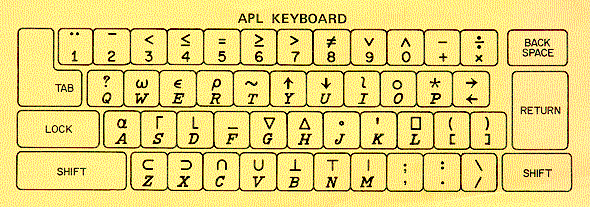
Actually, I learned some of my Greek alphabet from an obscure programming language that I learned at math camp, which led to a summer job programming in it for IBM. It's called APL (stands for the incredibly original name, "A Programming Language"). Here's an APL keyboard:
Here's some sample APL code:
Now that's what you call "all Greek to me"! Unless you've been indoctrinated into the secret society of APL programmers. I can't remember much of it anymore. Except that left arrow is an assignment operator, pronouned "gets" (as in "gets the value..."). So N←0 (in line 12) assigns the value 0 to the variable N. APL programmers pride themselves in writing the must unintelligible code ever. It is actually possible to write an entire quite functional APL program in just one line. The English text to the right of the funny character (upside-down U with a degree symbol superimposed in it) are comments, but the APL programmers who delight in being the most obscurantist possible would never use comments.
OK, sorry. I admit this has nothing whatsoever to do with Logos. Except for the fact that I learned some of my Greek alphabet from APL.
Actually I was a little unfair to myself. I know quite a few languages other than English - Assembler (multiple versions), FORTRAN, C, C++, C#, Basic, LISP, SNOBOL, PERL, Pascal......I may have forgotten some that I know.... :-) They're all Geek to me. Actually, I learned some of my Greek alphabet from an obscure programming language that I learned at math camp, which led to a summer job programming in it for IBM. It's called APL (stands for the incredibly original name, "A Programming Language"). Here's an APL keyboard: Here's some sample APL code: Now that's what you call "all Greek to me"! Unless you've been indoctrinated into the secret society of APL programmers. I can't remember much of it anymore. Except that left arrow is an assignment operator, pronouned "gets" (as in "gets the value..."). So N←0 (in line 12) assigns the value 0 to the variable N. APL programmers pride themselves in writing the must unintelligible code ever. It is actually possible to write an entire quite functional APL program in just one line. The English text to the right of the funny character (upside-down U with a degree symbol superimposed in it) are comments, but the APL programmers who delight in being the most obscurantist possible would never use comments. OK, sorry. I admit this has nothing whatsoever to do with Logos. Except for the fact that I learned some of my Greek alphabet from APL.
Thank you Rosie for the extra mile explanation.
I remember APL. We used to call it the world's only write-only language. Fixing bugs usually involved rewriting from scratch because no mere mortal could decipher it. :-)
Available Now
Build your biblical library with a new trusted commentary or resource every month. Yours to keep forever.