Hi - I have a question regarding Abraham.
He was called out out of a Pagan country, into Canaan a Pagan country.
Why do you think he insisted that only woman from he's own land would be acceptable for he's sons.
I would suggest that a broader question's results might be useful e.g. "In patriarchal times who were the potential spouses of a son i.e. what were the kinship constraints?" In an all smart search this yields:
In patriarchal times, kinship constraints for potential spouses were complex and culturally specific. The preferred marriage partner was typically a patrilateral cross-cousin, specifically a father’s brother’s daughter. Marriages were endogamous, meaning they occurred as close to the conjugal family as incest laws permitted, with cross-cousin marriages on the paternal side being considered ideal[1][2]. Marriages were fundamentally about fusing two extended families, with the honor of each family playing a key role. Marriage contracts were negotiated to ensure balanced reciprocity, and a bride-price was required to compensate for the loss of a family member. Interestingly, the strongest unit of loyalty was the descent group of siblings, rather than the marital relationship[2]. Anthropologists have noted that cross-cousin marriage was a common norm in many societies. The preference for such marriages was rooted in cultural kinship systems, where cross-cousins were considered ideal mates because they were outside one’s immediate lineage or clan, despite being closely related[3]. These kinship patterns were distinct to each cultural group and fundamentally different from modern Western family views, making an understanding of these social and cultural patterns crucial to interpreting biblical references to family[4].[1] John J. Pilch, A Cultural Handbook to the Bible (William B. Eerdmans Publishing Company: Grand Rapids, MI; Cambridge, U.K., 2012), 124. [2] Bruce J. Malina and Richard L. Rohrbaugh, Social-Science Commentary on the Gospel of John (Minneapolis, MN: Fortress Press, 1998), 167. [3] Robert A. Oden, “Jacob as Father, Husband, and Nephew: Kinship Studies and the Patriarchal Narratives,” Journal of Biblical Literature 102 (1983): 197–198. [4] William Raccah, “Sociology and the Old Testament,” in The Lexham Bible Dictionary, ed. John D. Barry et al. (Bellingham, WA: Lexham Press, 2016).
In patriarchal times, kinship constraints for potential spouses were complex and culturally specific. The preferred marriage partner was typically a patrilateral cross-cousin, specifically a father’s brother’s daughter. Marriages were endogamous, meaning they occurred as close to the conjugal family as incest laws permitted, with cross-cousin marriages on the paternal side being considered ideal[1][2].
Marriages were fundamentally about fusing two extended families, with the honor of each family playing a key role. Marriage contracts were negotiated to ensure balanced reciprocity, and a bride-price was required to compensate for the loss of a family member. Interestingly, the strongest unit of loyalty was the descent group of siblings, rather than the marital relationship[2].
Anthropologists have noted that cross-cousin marriage was a common norm in many societies. The preference for such marriages was rooted in cultural kinship systems, where cross-cousins were considered ideal mates because they were outside one’s immediate lineage or clan, despite being closely related[3]. These kinship patterns were distinct to each cultural group and fundamentally different from modern Western family views, making an understanding of these social and cultural patterns crucial to interpreting biblical references to family[4].
[1] John J. Pilch, A Cultural Handbook to the Bible (William B. Eerdmans Publishing Company: Grand Rapids, MI; Cambridge, U.K., 2012), 124. [2] Bruce J. Malina and Richard L. Rohrbaugh, Social-Science Commentary on the Gospel of John (Minneapolis, MN: Fortress Press, 1998), 167. [3] Robert A. Oden, “Jacob as Father, Husband, and Nephew: Kinship Studies and the Patriarchal Narratives,” Journal of Biblical Literature 102 (1983): 197–198. [4] William Raccah, “Sociology and the Old Testament,” in The Lexham Bible Dictionary, ed. John D. Barry et al. (Bellingham, WA: Lexham Press, 2016).
Note that the relevant issue is kinship not geography - the geography is simply the result of some of the extended family moving and some not.
Welcome @Johan
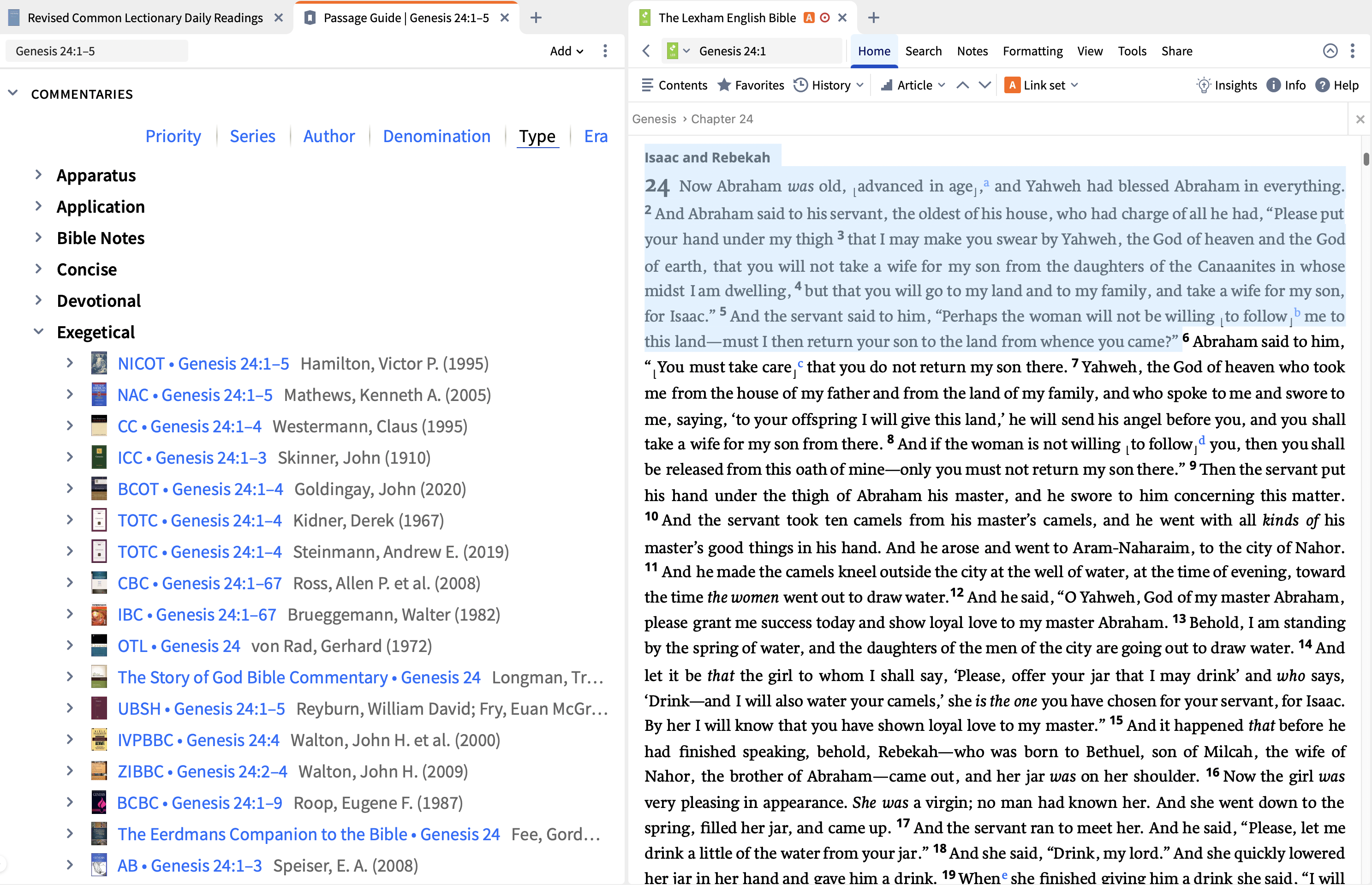
I assume you are basing your question on passages such as Genesis 24:1-5.
To explore this in Logos, I would run a Passage Guide on this passage and see what commentaries in your library have to say about it
I'm not answering your question directly as these forums are for discussing how to use Logos software and not really to explore different interpretations of scripture.
Graham
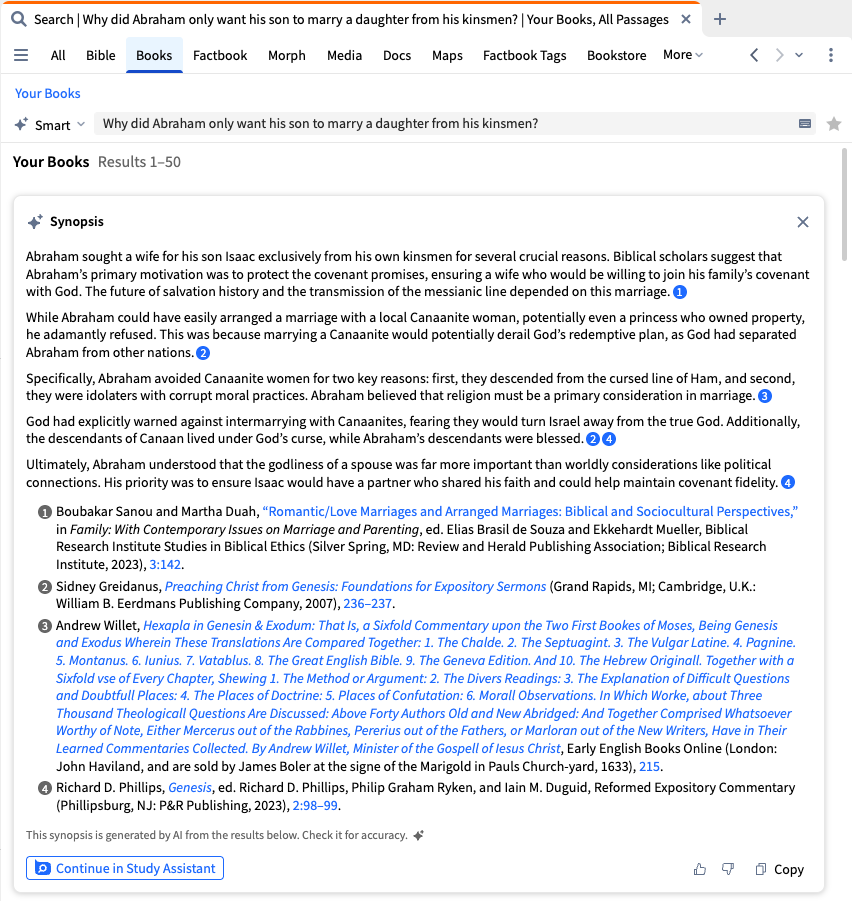
Also makes for a great Smart Search.
@Rick Mansfield (Logos) what an interesting screen copy. Of course, no offense (as always) but:
I wonder if the smart search would have 'from his land' (the op). I'd have to subscribe!
@Graham Criddle - thank you so much and my apologies. I am new to the Logos community thing, but very grateful for everyone here who assisted in the question.
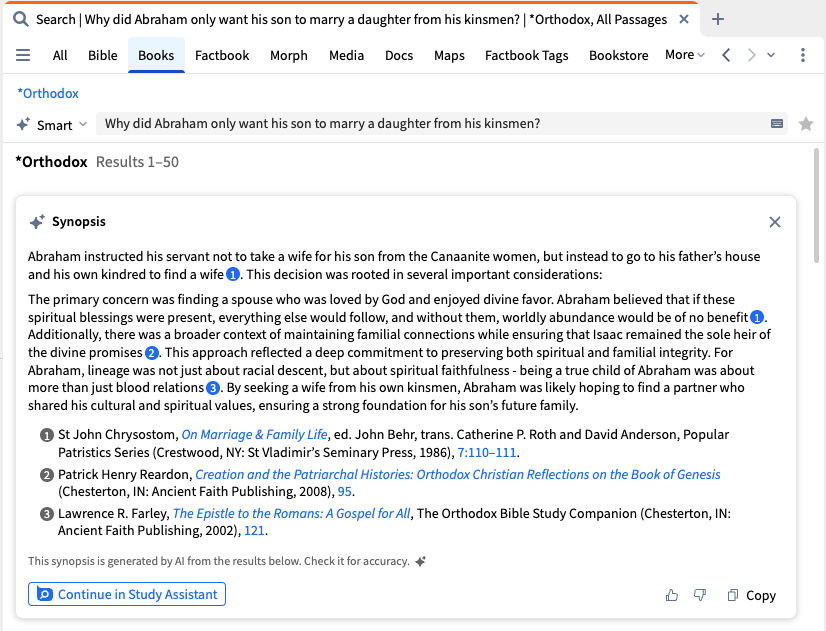
@DMB truthfully, I rarely search against my entire library because I have a kabillion books (having been a Logos user for a long time). I have a very specialized Collection I usually search against. It gave me this answer…
Available Now
Build your biblical library with a new trusted commentary or resource every month. Yours to keep forever.
What's the best way to find parallel accounts in other Gospels if I'm working with/in the Gospel of John? I know there's the Parallel Gospel Reader, but I would love if there was something faster, with synchronous scrolling alongside my open Bible tab. Is there anything I can link up like the Concordance Intertext tool…
I would like to use Preaching Mode when delivering my Wednesday night teaching for a Bible class. However, one of the key items I always want to emphasize is what is in the handout I give to them. I use Logos to create the handout from the message. Is there a way to use Preaching Mode and also see the statements I have…
I created an account maybe 20 minutes ago, i primarily dont have the liquid funds right now to make any major purchases, and as well wanted to see whats available already before seeing my needs if and when i would purchase further programming. Within the free version, i already see many resources at my disposal, however it…
Hello, I want to set up Logos on my wife's computer to where she can operate independently of my configurations. Does anybody have a suggestion as to how this can happen?
I have set out to analyse the various ways in which the concepts of number and counting are conveyed in the Pentateuch, and am having trouble making sense (pun intended :-) ) of some of the ways these are represented in the Bible Sense Lexicon. For example - on opening the lexicon and entering "first" in the search box,…