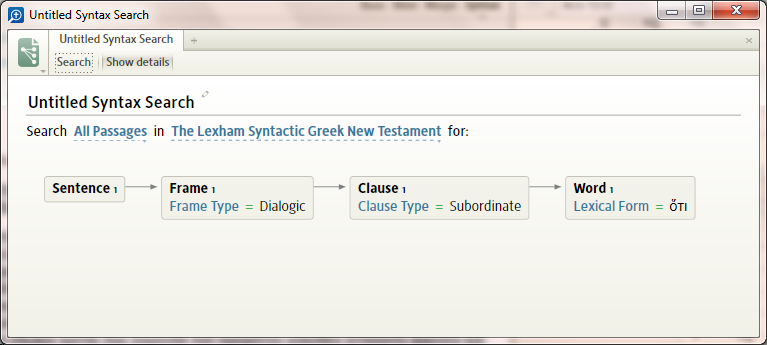
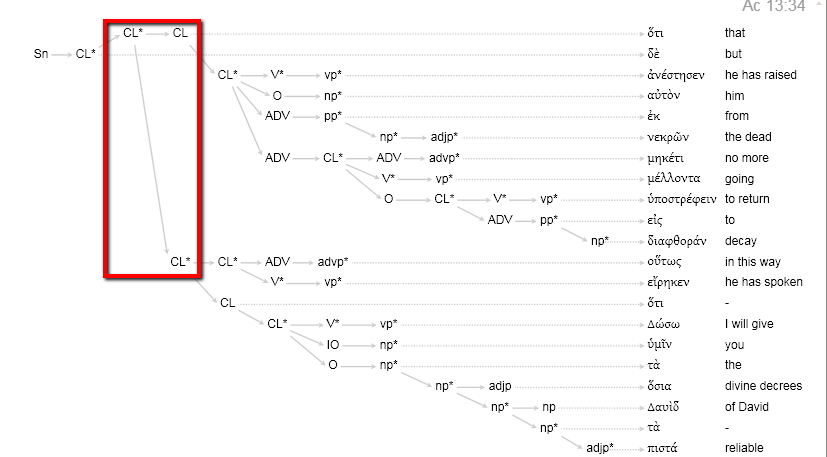
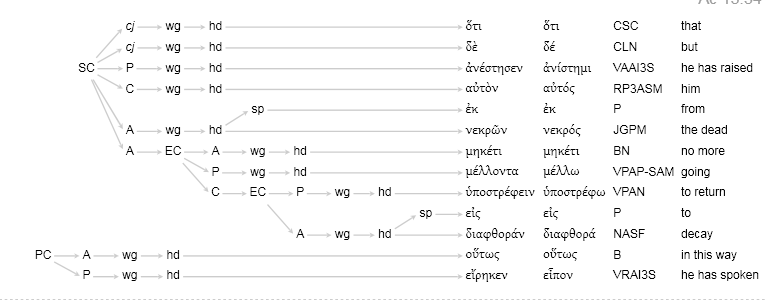
I often have trouble building syntax searches that give me what I'm looking for. Right now I am interested in Acts 13:34. The first oti there is usually understood to introduce a clause that is subordinate to the clause that follows, so ESV: "And as for the fact that he raised him from the dead, ... he has spoken in this way, ...." Some scholars (Rese, Strauss) have argued instead that this oti goes with the previous one: God has fulfilled his promise in that he raised up (in history) Jesus (33) AND in that he raised him from the dead (34). I began looking for how oti is used in Luke-Acts and elsewhere in the NT, and I'm having trouble finding a good parallel to either interpretation. Is oti ever used in the sense of "as for the fact that"? I'm not even sure what that would be called ... an adverbial clause modifying "said"? I did various syntax searches and couldn't find anything quite like it. The clause almost looks like a substantival, but it functions more adverbally. As for the interpretation of Rese and Strauss, I am not quite sure how they see this fitting: is the oti clause then an object of euaggelizomai in verse 32? This also seems puzzling since the oti of verse 33 does not define "what God fulfilled" (as Strauss implies), but apparently what "we" proclaim (it's an epexegetical oti clause?). Thoughts on how to find similar constructions based on either theory?