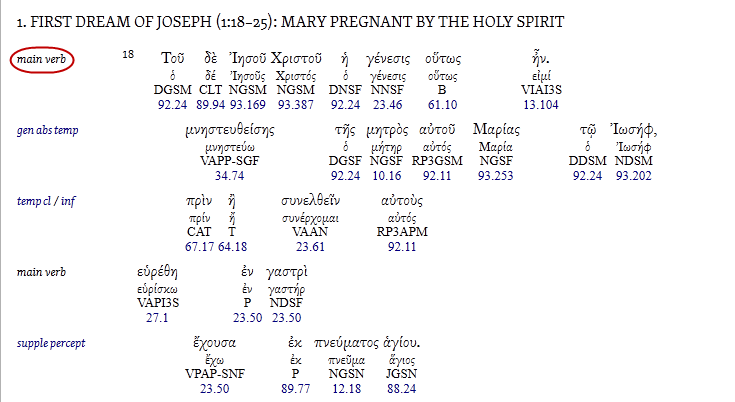
What marking does Deepe use to identify the main verb in the clause? I may be overlooking it...
I don't find Deepe in my library or on the Logos product page. To what product are you referring?
Spelled name wrong: it is Deppe....Lexham Clausal Outline of the New Testament.
Maybe I'm being dumb, but doesn't he just mark it "main verb"?
What marking does Deepe use to identify the main verb in the clause? I may be overlooking it... Maybe I'm being dumb, but doesn't he just mark it "main verb"?
Well, I am studying Philippians 2 and he does not. Opentext marks "complete" as the main verb, but Deppe just lists it as "verb imp." so that was the only example that I had, I am glad that he marks it clearly elsewhere, but he does not seem to be consistent in marking things as "main verb".
I find that the first main verb for Phil 2 actually occurs at 1:28 - then follow a number of participles. The next main verb occurs at 2:9.
How do you arrive at that conclusion based on the graph? So I guess the answer is that Deppe is NOT consistent in his marking of the main verb?
So I guess the answer is that Deppe is NOT consistent in his marking of the main verb?
No, my assumption is that he is consistent.
Everything between 1:28 and 2:1 is a subordinate clause of some sort - hence they are not main verb. The imperatives at 2:1 et. al. I know aren't treated as main verbs because:
Deppe does number parallel clauses sequentially to help one sort out the grammar. I find no front material or external glossary to verify if he wished "imperative" or "verb" to be labels treated as markers of independent clauses. So I may be wrong.
So I guess the answer is that Deppe is NOT consistent in his marking of the main verb? No, my assumption is that he is consistent. Everything between 1:28 and 2:1 is a subordinate clause of some sort - hence they are not main verb. The imperatives at 2:1 et. al. I know aren't treated as main verbs because: they are not labeled as such in Deppe they are treated as dependent/relative clauses in the corresponding clause visualization resource ... which I relied on because I don't really know Greek. Deppe does number parallel clauses sequentially to help one sort out the grammar. I find no front material or external glossary to verify if he wished "imperative" or "verb" to be labels treated as markers of independent clauses. So I may be wrong.
Verse 28 of Philippians 1 does not contain a PC (primary clause), thus it cannot contain the main verb, if I am reading the graph correctly. The main verb of that context is in verse 27, "lead your lives". And Deppe does not list that as the main verb, to which I would disagree. Deppe lists "and this from God" as the main verb saying that it is an understood verb there. Opentext has that listed as a secondary clause, with no verb; just a subject, adjunct and a specifier. So not being too familiar with Dean Deppe or his work, I am not completely sure of his thought process there but it does not seem to be correct as I look at the verses.
As a former student of Professor Deppe's, I have enjoyed reading this thread. I am not a scholar, but merely a seminary graduate and lay person.
I would say that Deppe is very consistent, but this resource does not fully explain his method. The preface in this resource gives the only briefest of introduction to the method behind the clausal outlines. My class notes were fairly light on this topic as well.
Looking at his preface, Deppe states the following: "A clause consists of a part of a sentence that includes a verbal element such as a main verb, an understood main verb, a participle or infinitive." Based on my understanding of this method, I would suggest that the word "imperitive" might be added to the list of verbal elements used by Deppe.
These verses have an extra degree of difficulty because they contain conditional statements. Wallace (Greek Grammar Beyond the Basics) speaks at length about conditional statements (see Semantic Categories of Conditional Statements). You might look to that resource as well. As a rule of thumb, the protasis (these four condition clauses) are dependent clauses. The apodosis (after the word 'then'), is generally treated as the main clause.
Philippians 2:1 contains four first class conditional statements, assumed to be true. ** Note how Deppe indents this protasis _beyond_ the imperitive in 2:2.
(4 log) if you have any encouragement from being united with Christ, if any comfort from his love, if any common sharing in the Spirit, if any tenderness and compassion,
Philippians 2:2 contains the imperitive, Deppe's "verbal element" , with an additional imperitive and other participles
(imper) then make my joy complete(imper iva) by being like-minded,.... having the same love.... being one in spirit and purpose
Michael - Using this method, the imperitive in verse 2 likely represents the "verbal element" you are seeking. You may want to look at other examples from Deppe (e.g. Galatians 5:15) to see how he treats the logical conditional statement and following verbs.
I just remembered that Deppe's book - All Roads Lead to the Text - is another Logos resource that may come in handy. See chapter 3: The Structural Analysis Route (Clausal Outlines). He explains his method in greater detail in this resource.
I hope this helps. I am not sure if this explanation is satisfactory to you, but I thought another voice would be helpful as you wrestle with the text.
Blessings! David
As a former student of Professor Deppe's, I have enjoyed reading this thread. I am not a scholar, but merely a seminary graduate and lay person. I would say that Deppe is very consistent, but this resource does not fully explain his method. The preface in this resource gives the only briefest of introduction to the method behind the clausal outlines. My class notes were fairly light on this topic as well. Looking at his preface, Deppe states the following: "A clause consists of a part of a sentence that includes a verbal element such as a main verb, an understood main verb, a participle or infinitive." Based on my understanding of this method, I would suggest that the word "imperitive" might be added to the list of verbal elements used by Deppe. These verses have an extra degree of difficulty because they contain conditional statements. Wallace (Greek Grammar Beyond the Basics) speaks at length about conditional statements (see Semantic Categories of Conditional Statements). You might look to that resource as well. As a rule of thumb, the protasis (these four condition clauses) are dependent clauses. The apodosis (after the word 'then'), is generally treated as the main clause. Philippians 2:1 contains four first class conditional statements, assumed to be true. ** Note how Deppe indents this protasis _beyond_ the imperitive in 2:2. (4 log) if you have any encouragement from being united with Christ, if any comfort from his love, if any common sharing in the Spirit, if any tenderness and compassion, Philippians 2:2 contains the imperitive, Deppe's "verbal element" , with an additional imperitive and other participles (imper) then make my joy complete(imper iva) by being like-minded,.... having the same love.... being one in spirit and purpose Michael - Using this method, the imperitive in verse 2 likely represents the "verbal element" you are seeking. You may want to look at other examples from Deppe (e.g. Galatians 5:15) to see how he treats the logical conditional statement and following verbs. I just remembered that Deppe's book - All Roads Lead to the Text - is another Logos resource that may come in handy. See chapter 3: The Structural Analysis Route (Clausal Outlines). He explains his method in greater detail in this resource. I hope this helps. I am not sure if this explanation is satisfactory to you, but I thought another voice would be helpful as you wrestle with the text. Blessings! David
David is correct. The main verb is found in verse 2, πληρώσατέ μου τὴν χαρὰν (you all fulfill my joy). Deppe simply notes that it is an imperative, which it is.
So I guess the answer is that Deppe is NOT consistent in his marking of the main verb? No, my assumption is that he is consistent. Everything between 1:28 and 2:1 is a subordinate clause of some sort - hence they are not main verb. The imperatives at 2:1 et. al. I know aren't treated as main verbs because: they are not labeled as such in Deppe they are treated as dependent/relative clauses in the corresponding clause visualization resource ... which I relied on because I don't really know Greek. Deppe does number parallel clauses sequentially to help one sort out the grammar. I find no front material or external glossary to verify if he wished "imperative" or "verb" to be labels treated as markers of independent clauses. So I may be wrong. Verse 28 of Philippians 1 does not contain a PC (primary clause), thus it cannot contain the main verb, if I am reading the graph correctly. The main verb of that context is in verse 27, "lead your lives". And Deppe does not list that as the main verb, to which I would disagree. Deppe lists "and this from God" as the main verb saying that it is an understood verb there. Opentext has that listed as a secondary clause, with no verb; just a subject, adjunct and a specifier. So not being too familiar with Dean Deppe or his work, I am not completely sure of his thought process there but it does not seem to be correct as I look at the verses.
You're right, verse 27 contains the main verb (not verse 28). Μόνον ἀξίως τοῦ εὐαγγελίου τοῦ Χριστοῦ πολιτεύεσθε. Only conduct your lives worthy of the gospel of Christ.
but this resource does not fully explain his method.
agree and this is unfortunate.
See chapter 3: The Structural Analysis Route (Clausal Outlines). He explains his method in greater detail in this resource.
Good to know especially as I have this.
David:
Thank you for your input...it was helpful to understand Professor Deppe. Yes, I thought that the main verb was in verse two as well; what led to my question was the way that opentext.org labeled the word versus Deppe; it seems that if Deppe thought this to be the main verb of the verbal element that it would have been clearer to tag it as "main verb" like he has in other places. Thank you for your input in this.
The main verb of that context is in verse 27
you are correct - initially a typo on my part.
it seems that if Deppe thought this to be the main verb of the verbal element that it would have been clearer to tag it as "main verb" like he has in other places.
yeah, something like "main verb (imp)"
Because the main verbs are identified within a paragraph, they can immediately see the big picture and not get lost in a forest of details. Dean Deppe, The Lexham Clausal Outlines of the Greek New Testament (Bellingham, WA: Logos Bible Software, 2006).
The key may be "main verbs are identified within a paragraph" Note "paragraph" not "sentence".
I do wish Logos wouldn't produce reference resources without a clear glossary.
Thanks for the discussion. Pastor Michael - blessings to you as you bring God's Word to your congregation.
Available Now
Build your biblical library with a new trusted commentary or resource every month. Yours to keep forever.