If you need more background see: http://www.orthodox.net/ustav/lectionary-for-the-kellia.html
There is a Bible reading plan based around the kellia markings in the Orthodox lectionaries i.e. New Testament minus Revelation which is not used in Orthodox liturgy (I think). These lectionary markings are intended for personal reading not liturgical readings (another set of markings in the lectionaries). All of which is a long way of saying I want to get the following into a reading plan:
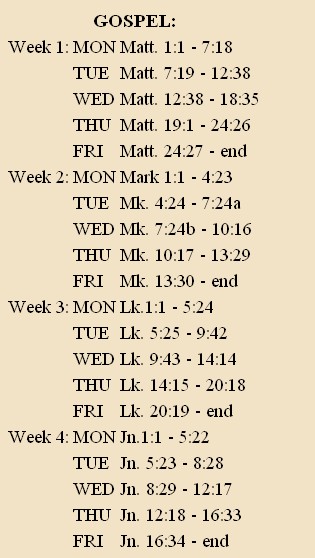
Now before you start complaining that I'm finding the obscure, it is not uncommon to have reading plans readings specified by day (name or sequential number). Think of the Zondervan reading plans, or most topical Bible studies.
It seems to me that there are three options:
1) all defined readings are entered as 'lectionaries' without calendar dates and those "lectionaries" can be treated as a reading plan. That is actual how the Orthodox handle it.
2) the reading plan expand its passage syntax to permit the designation of day boundaries, including null days. [the best option, I believe]
3) allow the use of kellias as boundaries just as chapters are used [wishful thinking but ...]
In this particular case, how one chooses to combine the Gospel and the Epistle kellia readings defines whether or not Saturday and Sunday are truly null ...