Hi - I have a question regarding Abraham.
He was called out out of a Pagan country, into Canaan a Pagan country.
Why do you think he insisted that only woman from he's own land would be acceptable for he's sons.
I would suggest that a broader question's results might be useful e.g. "In patriarchal times who were the potential spouses of a son i.e. what were the kinship constraints?" In an all smart search this yields:
In patriarchal times, kinship constraints for potential spouses were complex and culturally specific. The preferred marriage partner was typically a patrilateral cross-cousin, specifically a father’s brother’s daughter. Marriages were endogamous, meaning they occurred as close to the conjugal family as incest laws permitted, with cross-cousin marriages on the paternal side being considered ideal[1][2]. Marriages were fundamentally about fusing two extended families, with the honor of each family playing a key role. Marriage contracts were negotiated to ensure balanced reciprocity, and a bride-price was required to compensate for the loss of a family member. Interestingly, the strongest unit of loyalty was the descent group of siblings, rather than the marital relationship[2]. Anthropologists have noted that cross-cousin marriage was a common norm in many societies. The preference for such marriages was rooted in cultural kinship systems, where cross-cousins were considered ideal mates because they were outside one’s immediate lineage or clan, despite being closely related[3]. These kinship patterns were distinct to each cultural group and fundamentally different from modern Western family views, making an understanding of these social and cultural patterns crucial to interpreting biblical references to family[4].[1] John J. Pilch, A Cultural Handbook to the Bible (William B. Eerdmans Publishing Company: Grand Rapids, MI; Cambridge, U.K., 2012), 124. [2] Bruce J. Malina and Richard L. Rohrbaugh, Social-Science Commentary on the Gospel of John (Minneapolis, MN: Fortress Press, 1998), 167. [3] Robert A. Oden, “Jacob as Father, Husband, and Nephew: Kinship Studies and the Patriarchal Narratives,” Journal of Biblical Literature 102 (1983): 197–198. [4] William Raccah, “Sociology and the Old Testament,” in The Lexham Bible Dictionary, ed. John D. Barry et al. (Bellingham, WA: Lexham Press, 2016).
In patriarchal times, kinship constraints for potential spouses were complex and culturally specific. The preferred marriage partner was typically a patrilateral cross-cousin, specifically a father’s brother’s daughter. Marriages were endogamous, meaning they occurred as close to the conjugal family as incest laws permitted, with cross-cousin marriages on the paternal side being considered ideal[1][2].
Marriages were fundamentally about fusing two extended families, with the honor of each family playing a key role. Marriage contracts were negotiated to ensure balanced reciprocity, and a bride-price was required to compensate for the loss of a family member. Interestingly, the strongest unit of loyalty was the descent group of siblings, rather than the marital relationship[2].
Anthropologists have noted that cross-cousin marriage was a common norm in many societies. The preference for such marriages was rooted in cultural kinship systems, where cross-cousins were considered ideal mates because they were outside one’s immediate lineage or clan, despite being closely related[3]. These kinship patterns were distinct to each cultural group and fundamentally different from modern Western family views, making an understanding of these social and cultural patterns crucial to interpreting biblical references to family[4].
[1] John J. Pilch, A Cultural Handbook to the Bible (William B. Eerdmans Publishing Company: Grand Rapids, MI; Cambridge, U.K., 2012), 124. [2] Bruce J. Malina and Richard L. Rohrbaugh, Social-Science Commentary on the Gospel of John (Minneapolis, MN: Fortress Press, 1998), 167. [3] Robert A. Oden, “Jacob as Father, Husband, and Nephew: Kinship Studies and the Patriarchal Narratives,” Journal of Biblical Literature 102 (1983): 197–198. [4] William Raccah, “Sociology and the Old Testament,” in The Lexham Bible Dictionary, ed. John D. Barry et al. (Bellingham, WA: Lexham Press, 2016).
Note that the relevant issue is kinship not geography - the geography is simply the result of some of the extended family moving and some not.
Welcome @Johan
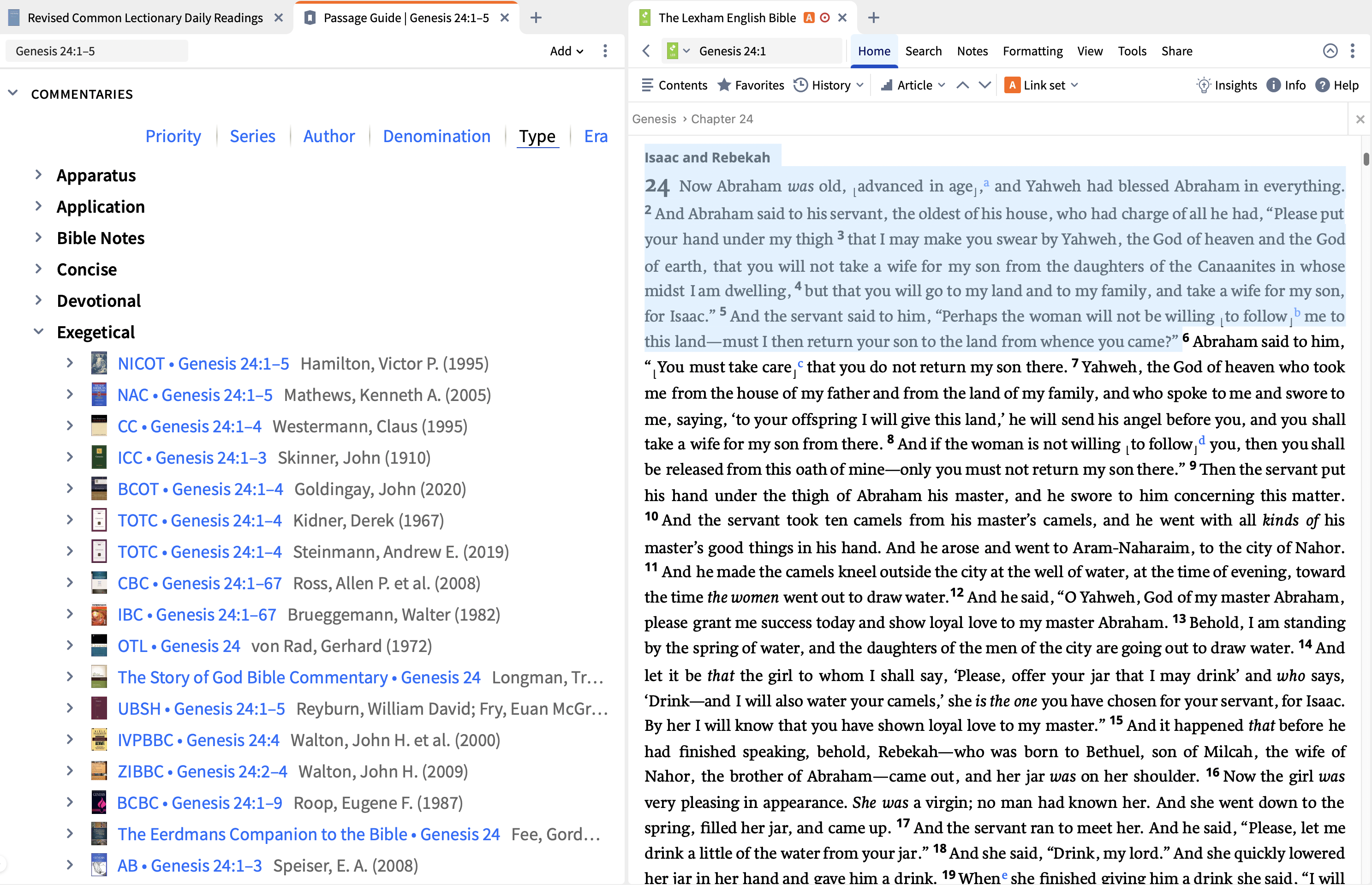
I assume you are basing your question on passages such as Genesis 24:1-5.
To explore this in Logos, I would run a Passage Guide on this passage and see what commentaries in your library have to say about it
I'm not answering your question directly as these forums are for discussing how to use Logos software and not really to explore different interpretations of scripture.
Graham
Also makes for a great Smart Search.
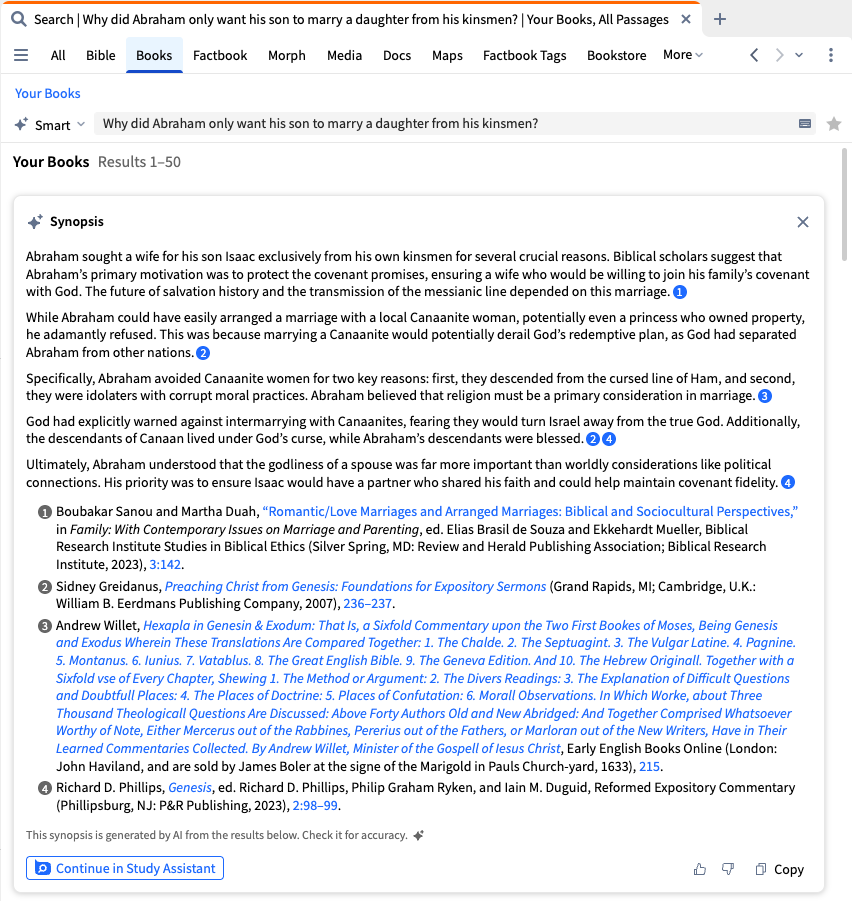
@Rick Mansfield (Logos) what an interesting screen copy. Of course, no offense (as always) but:
I wonder if the smart search would have 'from his land' (the op). I'd have to subscribe!
@Graham Criddle - thank you so much and my apologies. I am new to the Logos community thing, but very grateful for everyone here who assisted in the question.
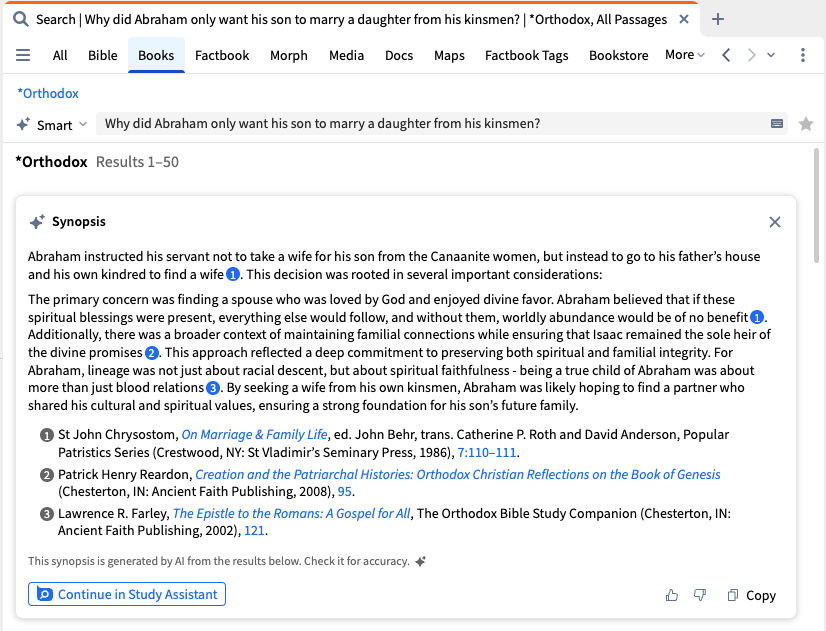
@DMB truthfully, I rarely search against my entire library because I have a kabillion books (having been a Logos user for a long time). I have a very specialized Collection I usually search against. It gave me this answer…
Available Now
Build your biblical library with a new trusted commentary or resource every month. Yours to keep forever.
I know that hermeneutics is interpretation of God's Word, but what am I missing? Am I missing anything? The best interpretation of the Bible comes from the Holy Spirit revealing the hidden meanings. I am halfway through my Pastoral Counseling and Addiction Recovery master's class. It is a shortened version rather than…
When I put my program in full screen three of my menus in the pull down menus at the top do not work correctly: Layouts, Tools and Guides. If I click on them they flash down and then close. They never open fully. I have had this problem since Apple updated its OS to Tahoe. I have reported it several times but seem to get…
Hi everyone, I am following up on the discussion regarding the addition of Serbian Bible translations to the Logos library.In a previous community post from early 2025, it was mentioned that the "Sveto Pismo - Novi Srpski prevod" (NSP) should be available sometime by August 2025. However, I am still unable to find it in…
When I open The Lexham English Bible Sometimes I have vaious things Highlighted that I didn't add and also Tabbed Highlights With Tabs "NT", "OT", etc. These don't seem to be "Notes" and I don't know how to turn then On or Off. As one example, I see that "NT" & "OT" identify "Quotes" from the "NT" & "OT", but don't see a…
I am trying to find a quote from a secondary source in the primary one. In this case, an author quoted Tertullian. I want to see this in Tertullian. I am aware that a lot of ancient works have multiple translations, so individual words may not be the same. So I am trying short phrases to help me find the original. I tried…