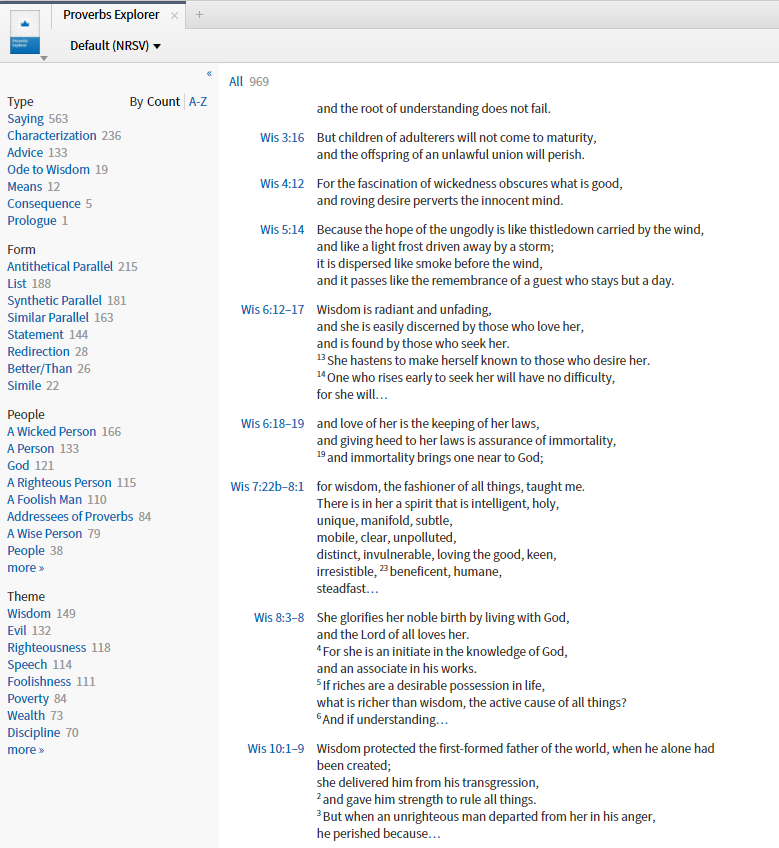
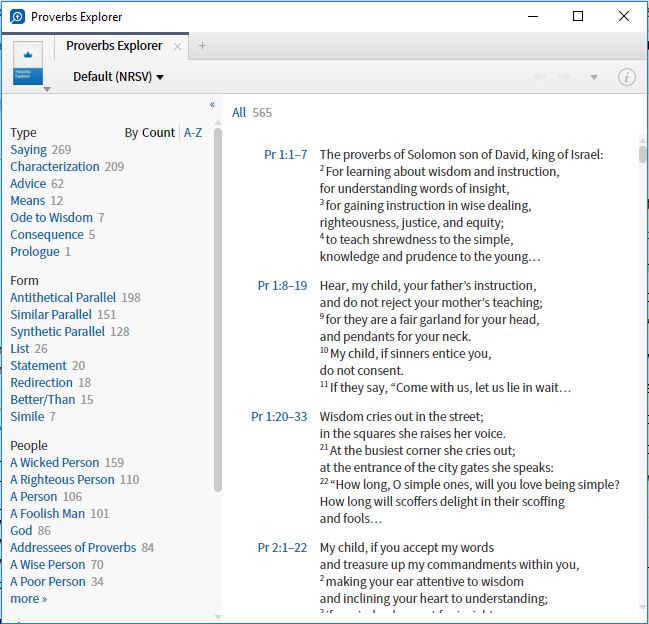
Is there a way to exclude references to the Apocryphal books?
Choose another Bible e.g. ESV instead of NRSV
Dave, I am using the ESV for the New Testament, but The Old Testament defaults to the NRSV for allusions and the LES for echoes. Those two produce the Apocryphal references.
IF the New Testament references what we call Apocryphal do we not want those references pointed out??
Currently many of 'us' ignore the Apocryphal writings. But are we correct to do so?? I think that study will be next on my list. Thanks for pointing out that that tool will do it.
David, you have a point, but I can see where Randall is coming from as well. At least, for a Protestant using the tool more for personal or ministry purposes, the normal assumption is that use of the Old Testament does not include apocryphal books. In fact, for some, the disagreement over considering these as Scriptures is so strong that they may find it somewhat offensive.
It would probably be best if there was the option to toggle it on or off. After all, it is true that there is also a place for studying the use of apocryphal books in the NT and apparently this tool can help with that as well.
At least, for a Protestant using the tool more for personal or ministry purposes, the normal assumption is that use of the Old Testament does not include apocryphal books.
Given the evidence of the LXX frequently being the text quoted, isn't that a bit of an anachronistic assumption? But seriously, I would expect it to simply use one's priorities for scripture and assume that the user is capable of determining whether or not it is canonical. How does the Proverbs Explorer work with the deuterocanonical texts? I would expect the behavior to be equivalent ... and if not, a bug may have been discovered.
Given the evidence of the LXX frequently being the text quoted, isn't that a bit of an anachronistic assumption?
If you found a user who takes a conversation on the forums in that kind of direction, I believe you would tell them to keep this for discussion groups on faithlife.com... [;)]
I would expect it to simply use one's priorities for scripture and assume that the user is capable of determining whether or not it is canonical.
Actually, I can easily envision some people who would not be able to because they don't have that knowledge yet.
How does the Proverbs Explorer work with the deuterocanonical texts? I would expect the behavior to be equivalent ... and if not, a bug may have been discovered.
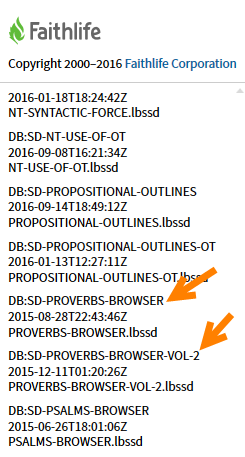
Proverbs Explorer is described as exploring sayings in the book of Proverbs.
Sorry, I don't have access at the moment but I don't believe that is still true. See Logos 6.9 https://community.logos.com/forums/p/121770/796408.aspx
Yours looks differently from mine (notice the different number of hits): verbum? beta? Logos Now?
If the tool is no longer intended for Proverbs only, they need to update the description in the information panel.
EDIT: MJ added a link in her msg above that shows that this is a feature of Logos Now.
In Full Feature Set Logos 7
Given the evidence of the LXX frequently being the text quoted, isn't that a bit of an anachronistic assumption? But seriously, I would expect it to simply use one's priorities for scripture and assume that the user is capable of determining whether or not it is canonical.
Just a quick observation MJ - I think Francis has made an important point about the apocryphal books - they are certainly not part of the Protestant canon as you would know. Some of us who hold to a conservative evangelical perspective do not regard the LXX as authoritative either. Fortunately, the Logos software provides tools so those of different perspectives can explore these issues for themselves - and that's a great blessing for us all. Sadly, in these days of a la carte Christianity, people may not know the importance of the canon, that it has been established and cannot be changed by the whims of individuals, so there may also be some value in tools addressing that issue. Keep well Paul
The purpose for my original post was to get a count of the different types that matches with the logos pro's video on this interactive. I certainly was not trying to start any sort of controversy.
Some of us who hold to a conservative evangelical perspective do not regard the LXX as authoritative either.
I'm aware of that and do support Logos supporting multiple canons. However, there is a genuine interesting question. In your resources various authors use different canons and no one complains ... or even notices because the citations don't say anything about whether or not it is a canonical book. It is up to the reader to decide. On the other hand, the searches within Logos allow one to limit the canon whether those searches are run through the search panel or one of the Guides. The interesting question is whether the interactives are more like a resource (I think of them as a Bible Handbook like Haley's) or more like a search? My personal opinion? They are more like a resource but should have a canon/Bible book facet.
Just a quick observation MJ - I think Francis has made an important point about the apocryphal books - they are certainly not part of the Protestant canon as you would know. Some of us who hold to a conservative evangelical perspective do not regard the LXX as authoritative either.
As I said before:
Now I will add: Once you find out that many of the quotes from the New Testament come directly from the Greek Old Testament as reported in the LXX instead of from the Hebrew Old Testament and that others come from the apocryphal books should you not review your beliefs on the LXX and the apocryphal books? If the New Testament authors used those resources why do we reject them?
[[Further comments probably belong on http://christiandiscourse.com/ ]]
Also:
Is there a way to exclude references to the Apocryphal books? The purpose for my original post was to get a count of the different types that matches with the logos pro's video on this interactive. I certainly was not trying to start any sort of controversy.
You are not starting ‘any sort of controversy’ we just do that naturally.
I think that study will be next on my list.
Müller, Mogens. The First Bible of the Church: A Plea for the Septuagint. Vol. 206. Journal for the Study of the Old Testament Supplement Series. Sheffield: Sheffield Academic Press, 1996. should be included in that study.
There are some interesting perspectives in this thread. Just to clarify - while I wrote that I wouldn't regard the LXX as authoritative, this doesn't mean I wouldn't find the LXX of interest or use it for comparative purposes. It just means where there is a direct conflict between the LXX and the canon, I would reject the LXX. There's nothing controversial there. Faithlife provides a great service in providing the electronic resources so we can explore these issues for ourselves and I do enjoy reading what people have to say in this forum. Keep well Paul
Sorry, I must not have expanded my Book (Source) list to see Apocryphal books. The bibles used for Apocrypha will correspond to what you Prioritised (I get mainly REB for allusions). But I had expected it to respect the canon of the chosen default bible (ESV)
I think that study will be next on my list. Müller, Mogens. The First Bible of the Church: A Plea for the Septuagint. Vol. 206. Journal for the Study of the Old Testament Supplement Series. Sheffield: Sheffield Academic Press, 1996. should be included in that study.
Already in my library and as Dave Hooton points out the Book(Source) selection makes the research easy.
[[Looked at a couple last night - Just because the same few words are used does not make a match - will go deeper]]
Available Now
Build your biblical library with a new trusted commentary or resource every month. Yours to keep forever.