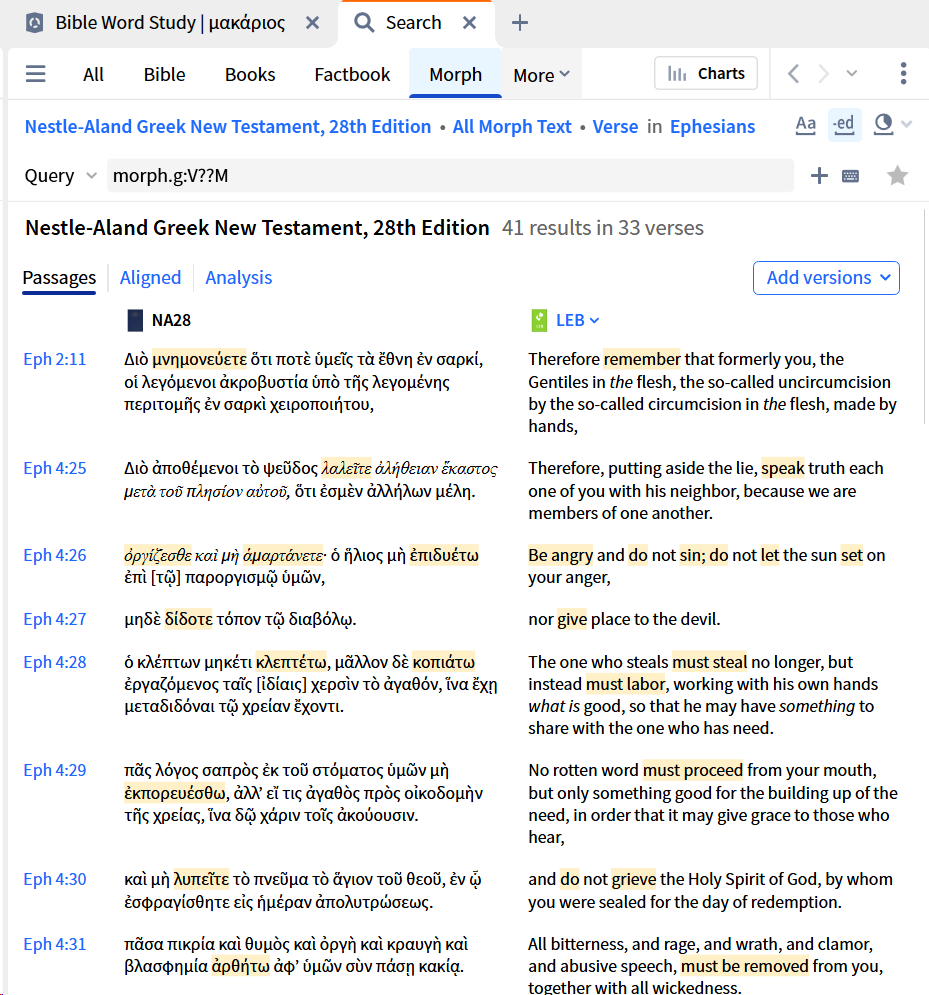
How do I use the search feature to find all the imperatives in a text? For instance… How do I find all the imperatives in the book of Ephesians? How do I find all the imperatives in Greek?
You need to do a morph search and you should end up with something like this
How do I find all the imperatives in Greek?
This type of search is done against the original language texts - so we can do them for Hebrew and Greek (and Aramaic) but not English
If the linked article doesn't give you the information you need please ask further.
@Graham Criddle - Hello Graham, Is this kind of search on the horizon for searching with Logos's AI using plain language? Example: "Search for all imperatives in the Greek New Testament"
I hope so, but currently the AI assistant in beta failed on this as it is designed to interact with the books in the library as a LLM but not use the search tools. I Currently the morph search is pretty easy to do after you understand the process, but it is definitely non-intuitive to start. I think there is a ton of room to have a natural language search that can translate into complex searches like morphological searches. This seems like it will be pretty obvious high-priority as Logos learns to implement AI.
It depends on your intent. If you want a comprehensive list, AI is not the way to go. If you want representative examples, AI could easily be on the horizon.
But what are the imperatives:-
"The Speech Acts of the Bible Dataset is complementary to the Sentence Types of the Bible Dataset. One (Sentence Types) involves formal criteria, the other (Speech Acts) involves pragmatic criteria focused on the volition or intent of the speaker/writer.
The complementary nature of these datasets can be better understood in the nature of commands. Formally, these are imperative statements as annotated by the Sentence Types Dataset. However, other types of statements can be intended as commands without using the formal structure of an imperative. For example, a mother may tell her daughter, “The stove is hot.” While formally a declarative sentence, it could be intended as a command to not touch the stove. The Speech Act Dataset is used to locate these more pragmatic usages. The combination of the two (formal and pragmatic instances) can provide a more complete list of commands or questions.". Parks, J. (2016). Sentence Types Dataset Documentation. Faithlife.
AI Bible Search for "Find the imperatives in John":- 95 verses in ESV AI Bible Search for "Find the imperatives in John":- 73 verses in SBLGNT 68 passages in common.
AI Bible Search for "Find the imperative words in John":- 74 verses in ESV. AI Bible Search for "Find the imperative words in John":- 58 verses in SBLGNT 53 passages in common
Precise Bible Search in John for sentence:"Imperative Sentence":- 101 verses in SBLGNT & ESV Precise Bible Search in John for speechAct:="Obligative: Directive":- 99 verses in SBLGNT & ESV 98 verses in common.
Available Now
Build your biblical library with a new trusted commentary or resource every month. Yours to keep forever.
I see that Logos will be releasing this title soon. However the product page does not provide a preview and also states that the Logos book does not include the text of the CSB. I have the CSB in Logos already, that’s not an issue, my question is how has Logos formatted the book, especially given the contextual structure…
What happened to HDOT
I am still having problems getting results from Verbum. Most times, I am searching either for the source of a quotation or finding a homily(ies) on a specific topic. or the Ante-Nicean Fathers. Also, I love to browse to learn more about what a section contains, but I find it frustrating when I cannot browse the contents of…
I have been going through Exodus as a sermon series at church and nearing the end of the study, but I noticed that a few sermons are "missing" or lost when I look through the Sermon Manager. I recently found them, but Logos is not grouping them together, even though they have the same sermon series title, etc. One or two…
I have made a custom Bible reading plan. I have it available in ics-format. Is it possible one way or the other to import this ics-file into a Logos reading plan?