Several years ago I began reading John Owen in a Paperback book titled "Overcoming Sin and Temptation (Redesign): Three Classic Works by John Owen".
I was talking with a friend today and remembered something I had read. I do not remember exact wording so i cannot provide a quotation. So I thought it might be something where I could use AI to find it easily.
I actually tried ChatGPT first. It gave impressive results, but did not narrow it down enough that I was still unable to find the place easily.
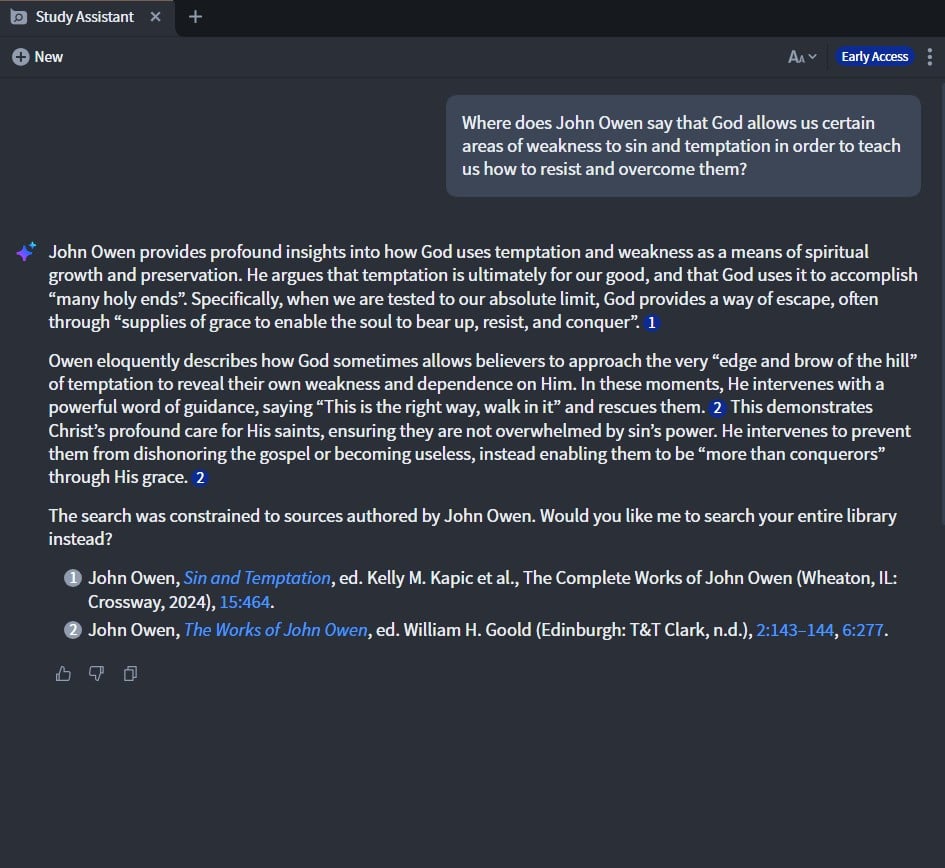
So then I tried Logos. I entered the exact same question into Logos that I had entered into ChatGPT.
Since this is the Logos forum, I will show Logos results first. They are practically worthless. Maybe I am doing something wrong. Maybe someone can show me a better way?
QUESTION: where does John Owen say that God allows us certain areas of weakness to sin and temptation in order to teach us how to resist and overcome them?
Since I had specifically specified an author (John Owen), and I have the complete works of John Owen in my Library, I was expecting good results.
Results: After carefully reviewing the provided excerpts, I cannot find a direct quote from John Owen stating that God allows us certain areas of weakness to sin and temptation specifically to teach us how to resist and overcome them. Owen does discuss how people can overcome patterns of sin through “concentrated prayer, obedience, and the penetration of the truth of the gospel,” and suggests that a person’s sorrow over sin is actually a sign that sin does not reign in them1. Additionally, the sources indicate that Satan tends to attack people at their weakest points, and those seeking to grow spiritually must resist and fight against these temptations in faith2. However, the specific theological claim about God intentionally allowing weakness to teach resistance is not explicitly stated in these excerpts. 1Timothy J. Keller, “Puritan Resources for Biblical Counseling,” The Journal of Pastoral Practice, ed. Jay E. Adams (1988), 9:3:28.2Thomas Boston, The Whole Works of Thomas Boston: Sermons and Discourses on Several Important Subjects in Divinity, ed. Samuel M‘Millan (Aberdeen: George and Robert King, 1849), 629.
This was a disappointment, because in my question I never asked for a direct quote. It gave up and reported failure, without giving any hint that it actually utilized any of Owens actual writings. All of the references it gave are to third party discussion of other topics and not anything written by Owen.
In the following list of results, there were dozens of quotations from third party resources, which would have taken a long time to sort thru … which defeated the purpose of using AI. There were only a few quotations from Owen himself, and they were buried so far down the list that at first glance I thought it didn't have any. But none of the quotes was remotely relevant to the question I asked.