“Some people see things as they are and ask 'Why?' Others...” I'm probably, sadly, more in that first group.
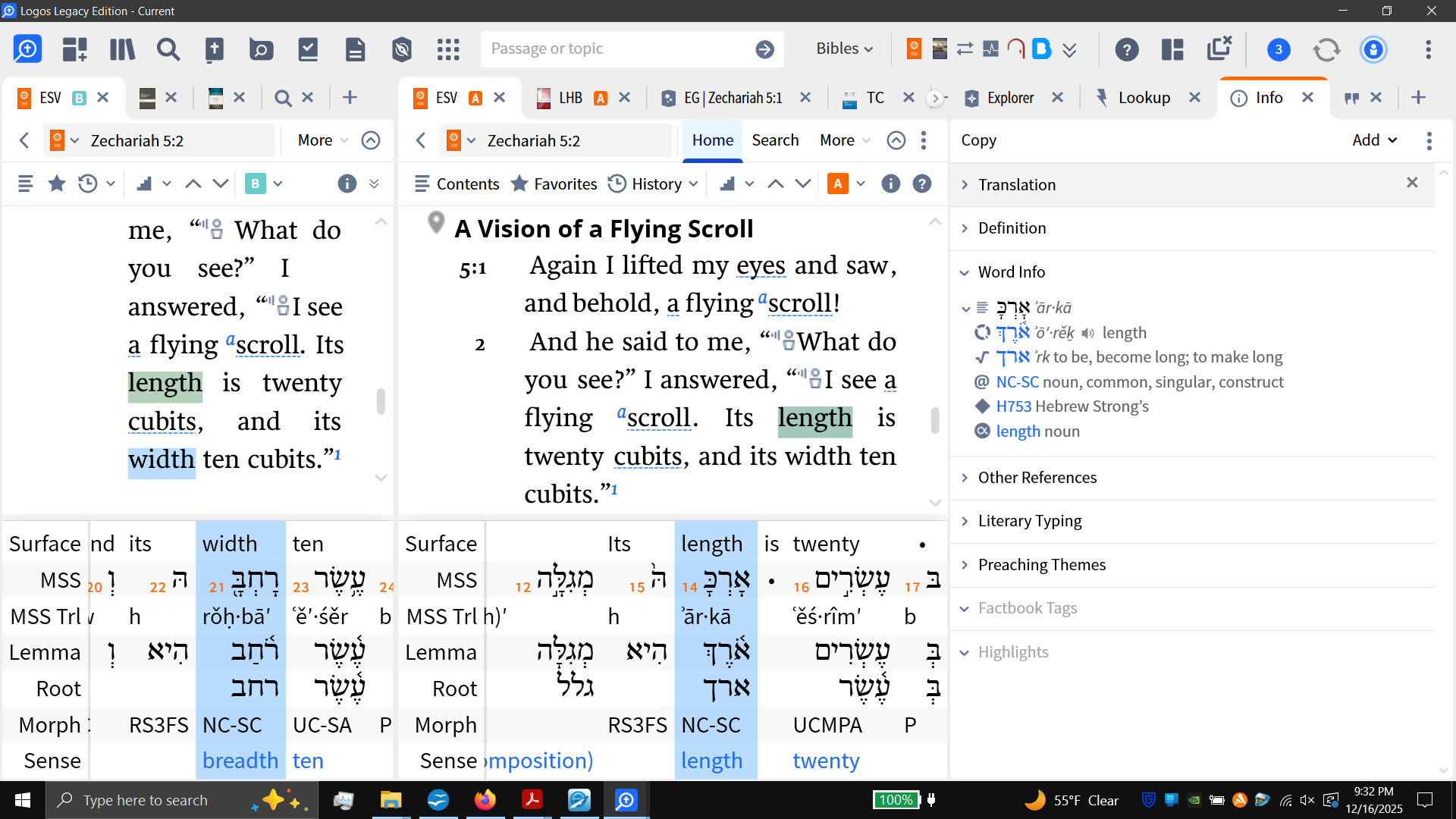
Can't help but wonder how a reverse interlinear assigns 2 different transliterations for such similar constructions in Zc 5.2.
Even in English, “it's length” and “it's width” are similar; but it's harder to conceive of more similar constructions in Hebrew:
[Both are two syllable nominal constructions (both original N m.s. forms with cholem first vowel; that reduces to qamets chatuph with addition of a pronominal suffix), a begadkephat final noun consonant with daghesh lene following silent shewa, with added/same pronominal suffix and same mappiq in final heh suffix consonant, ultima accents; both even have a guttural second consonant and “distinctive” first consonants (aleph and a guttural), and both have, properly, short qamets chatuph first vowel in a closed, unaccented syllable (cf. Text converter shows 'orkah for “it's length,” for the full construction).]
Yet, although the RI slices and dices both in the same place, one is transliterated as qamets (incorrectly, in the RI and other places in Logos), and the other correctly as chatuph, in the first syllables.
The only difference is that the accent on the ultima is placed with the separated C, heh, for the “post-positive” accent, Vs. kept with the final qamets for the other. Does that impose some kind of unique syllable count rule in an algorithm? And how or why would that affect the reading of the qamets sign in the closed first syllable of either (both without first syllable tone-stress)?
Possibly if someone would kindly explain these different results, it would help me understand many such “differences” in BH transliterations in Logos.