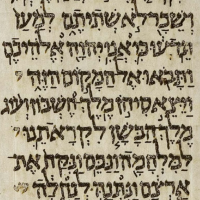
I'd like to do searches on waw-consecutive third-he verbs that end in a he (but a he that's not a pronominal suffix). Can this be accomplished through the morph search?
Your example from Gen. 19:16 has a He with a mapiq. This is treated as a separate class of verbs in most tagging systems. So I suggest you split your search into two. I'll also try.
Here is a simple search for III-He (guttural) verbs:
The last result has a suffix, but still the verb itself does end in a He
I think this is it! See what you think:
That’s it! Thank you KeenUser!👍
This thread was super helpful. Thanks to all.
I agree Brian, I am enjoying learning how to do these kinds of searches in Logos.👍️
Any ideas?
Not being a student of Hebrew, the LExham Hebrew Bible provides a seach for waw-consecutive+imperfect = "Waw consecutive" = "wayyiqtol" and pargogic-he ending i.e. morph.h:V?W3????H. Which is not specified as pronomial
I'm trying to see ifLogos can find these search results:
So far, these are the results that I'm getting which aren't accurate for this partiicular search:
I haven't double checked this because I'm running between classes.
Here's another attempt trying to eliminate pronominal suffixes. I could have sworn I saw something above about paragogic ה, and that's what I was trying to eliminate in the first screenshot.
Maybe third time is closer to the charm. There's some false hits here though.
Brian,
The third search that you attempted is a lot closer but it still does not pick up וַֽיִּתְמַהְמָ֓הּ in Genesis 19:16. Thank you for getting me on the right track.
Available Now
Build your biblical library with a new trusted commentary or resource every month. Yours to keep forever.
I have been eagerly awaiting the release of my pre-pub order of Exalting Jesus in Numbers (Christ-Centered Exposition Commentary | CCE) and I saw that it was supposed to be today 04/15/26. I refreshed my pre-pub orders page but now it doesn’t have a date of when I can expect it. Has it been pushed back? To when?
I have the NET Bible, both first and second editions. I learned today that this Bible is known for its notes. So i opened the Bible and I don't see any notes. So I'm thinking, Logos probably has the notes as a separate resource. I see that Logos has a Study Bible of the first edition of the NET notes. But I see nothing for…
I have created several notes tagged to each of the paragraphs in the Catechism of the Catholic Church, 1st Ed., however, when moving to the newer 2nd Edition, my tags (notes) no longer show. Is there a way to get those tags (notes) moved from the 1st Ed. to the 2nd Ed.?
I was recommended to find "B.B. Warfield, The Inspiration and Authority of Scripture (Presbyterian and Reformed Publishing), ch. 1." I have this, B. B. Warfield Collection (20 vols.) | Logos Bible Software, which includes The Works of Benjamin B. Warfield, Vol. 1: Revelation and Inspiration | Logos Bible Software. How do I…
After reading Philippians 1:1, I was curious to find out how many times δοῦλος was used appositionally in the New Testament. I did the Syntax Search seen in the image but there are results missing such as James 1:1. How do I construct a better syntax query to get every instance to show up in my search.