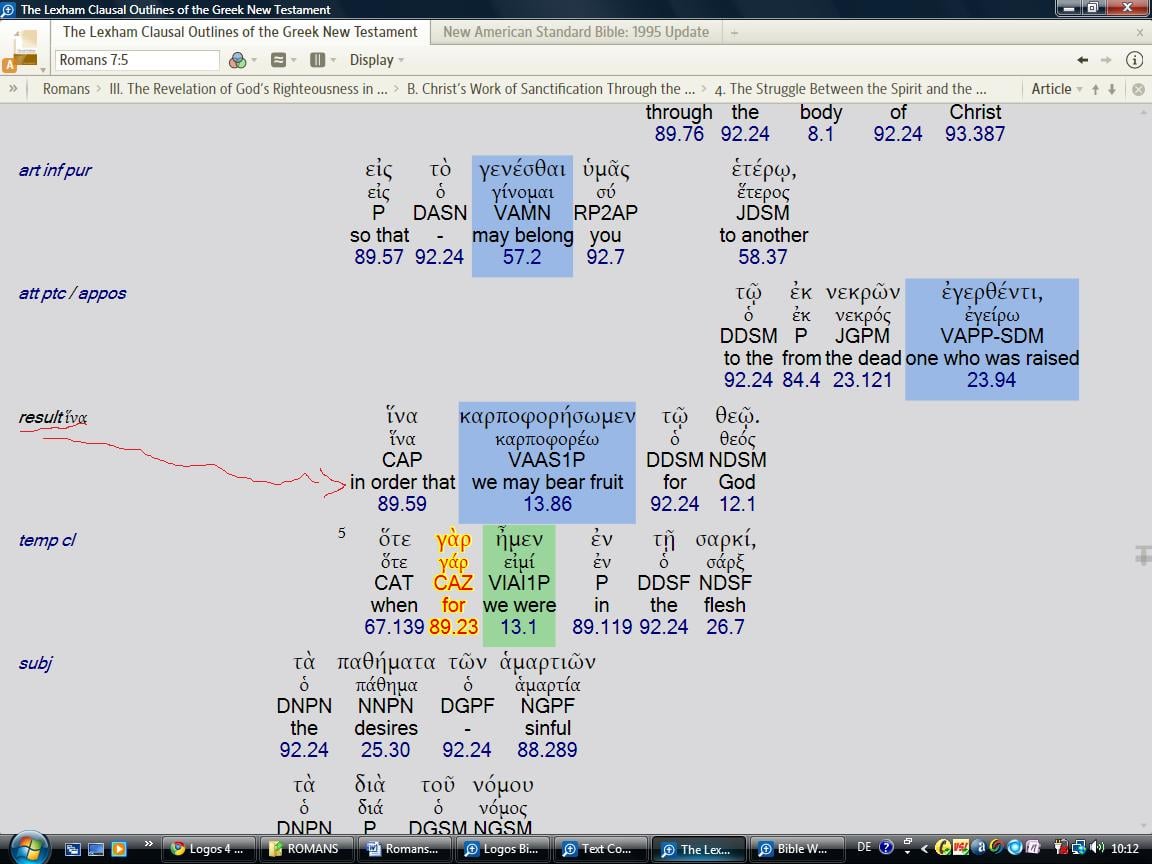
“My problem is here, in Romans 7:4, where it shows ‘result’ by the red arrow. Why does this show as a result? Is this really a result? I thought it to be purpose. Please help me understand this
Hello, Tes:
I saw your original post seven hours ago and thought, "Nichts verstehe", because I did not understand what you were trying to accomplish.
If you describe your problem in more detail, perhaps someone can offer help.
Jack
I agree, it looks like purpose. ἵνα seems to mean in order to. I can;t find a record of it meaning "with the result that". I wonder if their thinking is that God's purpose also gets fulfilled??[^o)]
The word ina can be translated as a cause or as a result.
Like in Mark 4:12 so that “they may indeed see but not perceive, and may indeed hear but not understand,
The Holy Bible : English standard version. 2001 (Mk 4:12). Wheaton: Standard Bible Society.
that some people do not hear or see is a result of their own rebellious hart and not caused by God...
Like with Farao's hardening of his hart, God only strenghtened Farao after the so many times that farao had hardenen his hart himself.
The same in ypour text in Romans... the result is that we may bear fruit.
The word ina can be translated as a cause or as a result. Like in Mark 4:12 so that “they may indeed see but not perceive, and may indeed hear but not understand, The Holy Bible : English standard version. 2001 (Mk 4:12). Wheaton: Standard Bible Society. that some people do not hear or see is a result of their own rebellious hart and not caused by God... Like with Farao's hardening of his hart, God only strenghtened Farao after the so many times that farao had hardenen his hart himself. The same in ypour text in Romans... the result is that we may bear fruit.
Hi Ton,so if this one is result ,that means we have double results ,with "so that" .Is there any possibility to figure ouit sentences or phrases such as this whether it is purpose or result.
It isn't result, but purpose.
409.
Tes, note sure if this helps you in thinking about is usage:
2443. ἵνα hína; conj. That, so that, for the purpose of, construed usually with a subjunctive, seldom with the opt., often with the indic. marking the end, purpose. Also used to indicate the cause for, or on account of which anything is done. Can be translated, “to the end that,” “in order that it might [or may] be.” It may also be used simply to indicate a happening, event or result of anything, or that in which the action terminates. Hína can be translated “so that it was [is, or will be].”Zodhiates, S. 2000. The complete word study dictionary : New Testament (electronic ed.). AMG Publishers: Chattanooga, TN
Also this might help further in thinking about the issue.
If you don't have the Lexham DIscource Greek NT Bundle, then I would recommend you consider it when you have the funds to do so. The AMG Bible Essentials from which that dictionary reference earlier came can also be a nice to have and check. While LSJ & BDAG are the top greek reference lexicons to have this one is easier to read and so if used alongside the others it can be beneficial at times.
If you don't have the Lexham DIscource Greek NT Bundle, then I would recommend you consider it when you have the funds to do so. The AMG Bible Essentials from which that dictionary reference earlier came can also be a nice to have and check. While LSJ & BDAG are the top greek reference lexicons to have this one is easier to read and so if used alongside the others it can be beneficial at times .
.
Hi Andrew, thank you, I have been studying the book ofRomans since January, I love to study word by word, it is my favorite to digout and study the Word of God, I cannot wait about the book you have mentioned.I have tried to see in the products section of Logos, I am not sure ,whether itis the one which is shown on pre-bub ,price $149.95? http://www.logos.com/search?q=Lexham+discourse+Greek+NT+Bundle Ineed your confirmation,and need as well some more explanation for my excitment.
BDAG
I have the BDAG, since I have the Platinum
It isn't result, but purpose. 409. Εἰς governing the Infinitive with τό
Εἰς governing the Infinitive with τό
Hi George, but hier is "ἵνα" mentioned ,I haven't understood your quotation. Would be glad for more clarification.
Rhetorical Disposition IV. The probatio 5:1—8:39 B. The second proof: Life in Christ as a new system of honor that replaces the quest for status through conformity to the law 7:1–6 5. Syllogism concerning life in Christ as freedom from the law 7:1–3 a. The premises based on marital law 7:1 1) A dialogical exchange containing the major premise concerning the jurisdiction of the law 7:1a-b a) The address to believers adept in the law 7:1a (1) The rhetorical address to “brothers” 7:1b (2) The specification of the audience as adept in the law 7:1c b) The major premise about law having jurisdiction only during a lifetime 7:2–3 2) The minor premises in the structure of marital law 7:2 a) First minor premise: marital law is binding only until death 7:2a (1) The law binds a woman to a man only during his lifetime 7:2b (2) When a husband dies the wife is released from marital law 7:3a-b b) Second minor premise: adultery is defined only during the lifetime of a husband 7:3a (1) A woman can be called an adulteress if the husband is alive 7:3b (2) The requisite condition of adultery: relations with another man 7:3c-d c) Third minor premise: after the death of a husband a woman cannot be legally defined as an adulteress 7:3c (1) When the husband dies the wife is free from marital law 7:3d (2) Thus a woman having relations with another man is not an adulteress 7:4–6 b. Conclusion: the witness of Christian experience to freedom from the law 7:4a-b 1) The first inference concerning believers as dead to the law 7:4a a) The address to believers as “my brothers” 7:4b b) The inference: (1) Believers are now “dead to the law” (2) The means: “the body of Christ” 7:4c-d 2) The second inference of Christian death to the law 7:4c a) Believers are given a new relationship to the resurrected Christ 7:4d b) The purpose of the new relationship is to bear fruit for God 7:5–6 3) The explanation in terms of religious experience 7:5 a) The prior experience of law leading to death 7:5a (1) The function of the law before conversion (a) The status of being “in the flesh” prior to conversion (b) Law as the means by which passions became sinful 7:5b (2) The effect of passions corrupted by the law (a) The bodily arena of sinful passions (b) The deadly fruit of the passions 7:6 b) The current experience of freedom from the law and slaves to Christ 7:6a (1) Freedom from the law through death (a) Believers are now released from the law (b) Believers have died to the constricting law 7:6b (2) The new Christian slavery (a) The positive definition of slavery as “newness of Spirit” (b) The antithesis of slavery “in the obsolete letter”Robert Jewett, Roy David Kotansky and Eldon Jay Epp, Romans : A Commentary, Hermeneia--a critical and historical commentary on the Bible, 429 (Minneapolis: Fortress Press, 2006).
The “in order that” clause refers to productive transformation on the part of those who have died with Christ: ἵνα καρποφορήσωμεν τῷ θεῷ (“in order that we might bear fruit for God”). This verb appears only in this and the following verse in all of the indisuptable Pauline letters, and is found also in Col 1:6*, 10*. None of the NT occurrences of this verb shares the legal context of 4 Ezra 9.31*, “For lo, I sow in you my law, and it shall bring forth in you the fruits of righteousness.”49 While some interpreters have faulted Paul for seeming to shift his metaphor to the agricultural realm,50 a good case can be made that a figurative form of productivity in a general sense including childbearing is in view.51 Matthew Black infers that “the believer is free to contract a new union with his Risen Lord, and obtain new progeny through this fresh ‘marriage.’ ”52 This provides an excellent correlation with the missional purpose of Romans, because Paul hopes that by acknowledging the marriage between Christ and each of the house and tenement churches, they will discover their commonality and cease the competition that would discredit the gospel to the barbarians in Spain. Paul places the purpose of their joint marriage with Christ in the first person plural, because he hopes to join with the Roman churches in planning and mounting this mission to bear God further fruit of converts. When the Spaniards hear the gospel, they will discover that despite the contempt in which they had formerly been held, especially by their Roman conquerers, they along with all others are rightful children of God. But this can happen only if the Roman house and tenement churches realize that their marriage to Christ means they have died to the law, because their continued insistence on the priority of particular laws was the motivation for their discrimination against each other. This persistence of the social habits of judging and contempt, typical for honor-shame societies,53 would inevitably carry over into their attitude toward the barbarians in Spain, and thus erode the credibility of the gospel. If the house and tenement churches of Rome could grasp the true dimension of their marriage to Christ, they would be enabled to share in Paul’s mission to restore “to God” his rightful children in Spain, thus completing the task of bringing the Gentiles as an offering to God (Rom 15:16*), which Isaiah had hoped would usher in the end of the age (Isa 66:20*). However, “bearing fruit” is too generic a formulation to be restricted to this missional context. Paul assumes that believers will recover the Adamic responsibility to care for the creation, a theme that is developed in chap. 8. Their conversion is not an end in itself, but serves the larger purpose of recovering the role of co-creators with God. Whatever their form of work, whether as slaves or self-employed handworkers, whether as widows engaged in congregational work or even as patrons who are directing their energies toward productive congregational enterprises for the first time, their goal is no longer the attainment of honor but service to God.Robert Jewett, Roy David Kotansky and Eldon Jay Epp, Romans : A Commentary, Hermeneia--a critical and historical commentary on the Bible, 435-36 (Minneapolis: Fortress Press, 2006).
Does this help you Tes? There's a logic side as well as a linguistic side in this passage.
It isn't result, but purpose. 409. Εἰς governing the Infinitive with τό Hi George, but hier is "ἵνα" mentioned ,I haven't understood your quotation. Would be glad for more clarification.
You did say you were in Germany, did you not? "Hier" for "here." [:)]
I thought it fairly straight forward that when ἵνα with the subjunctive appears it is taken as a purpose clause so I thought you were referencing εἰς τὸ γενέσθαι. Note the entry in BDAG on ἵνα here (or Hier).
① marker to denote purpose, aim, or goal, in order that, that, final sense
It isn't result, but purpose. 409. Εἰς governing the Infinitive with τό Hi George, but hier is "ἵνα" mentioned ,I haven't understood your quotation. Would be glad for more clarification. You did say you were in Germany, did you not? "Hier" for "here." I thought it fairly straight forward that when ἵνα with the subjunctive appears it is taken as a purpose clause so I thought you were referencing εἰς τὸ γενέσθαι. Note the entry in BDAG on ἵνα here (or Hier). ① marker to denote purpose, aim, or goal, in order that, that, final sense ⓐ w. subjunctive, not only after a primary tense, but also (in accordance w. Hellenistic usage) after a secondary tense (B-D-F §369, 1; Rob. 983; Mlt-Turner 100–102; JKnuenz, De enuntiatis Graecorum finalibus 1913, 15ff):α.after a present tense Mk 4:21; 7:9; Lk 6:34; 8:16; J 3:15; 5:34; 6:30; Ac 2:25 (Ps 15:8); 16:30; Ro 1:11; 3:19; 11:25; 1 Cor 9:12; Gal 6:13; Phil 3:8; Hb 5:1; 6:12; 1J 1:3 and oft.β.after a perfect Mt 1:22; 21:4; J 5:23, 36; 6:38; 12:40, 46; 14:29; 16:1, 4; 17:4; 1 Cor 9:22b al.γ.after a pres. or aor. impv. Mt 7:1; 14:15; 17:27; 23:26; Mk 11:25; J 4:15; 5:14; 10:38; 1 Cor 7:5; 11:34; 1 Ti 4:15; Tit 3:13. Likew. after the hortatory subj. in the first pers. pl. Mk 1:38; Lk 20:14; J 11:16;Hb 4:16. δ. after a fut. Lk 16:4; 18:5; J 5:20; 14:3, 13, 16; 1 Cor 15:28;Phil 1:26. ε. after a secondary tense: impf. Mk 3:2; 6:41; 8:6; Lk 6:7; 18:15 al.—Plpf. J 4:8.—Aor. Mt 19:13; Mk 3:14; 11:28; 14:10; Lk 19:4, 15; J 7:32; 12:9; Ro 7:4; 2 Cor 8:9; Hb 2:14; 11:35;1J 3:5.
You did say you were in Germany, did you not? "Hier" for "here."
ⓐ
Hi George I am still in Frankfurt the heart of Germany.Not far from the airport.Yes I have misspelt it.I couldn't understand how the verses relate to purpose.Is it possible to search all the positive and negative words or phrases of purpose in visual filter?
Does this help you Tes?
Yes,MJ.Smith, thank you. It is wounderful ,how can I get these resources?
how can I get these resources?
Logos carries Hermeneia in several combinations - Old Testament, New Testament, both ... it's been on sale recently at a "steal" ...
how can I get these resources? Logos carries Hermeneia in several combinations - Old Testament, New Testament, both ... it's been on sale recently at a "steal" ...
Thank you sister.
Hi Tes,
The Greek Bundle which can be purchase now costs $149.95
The Hebrew Bundle is on Pre-Pub currently at $199.95
Hi Tes, The Greek Bundle which can be purchase now costs $149.95
Broken link (the word "which" was somehow included in it). Here's the correct link: http://www.logos.com/products/details/3887
Does this help you Tes? There's a logic side as well as a linguistic side in this passage .
Dear MJ:Smith ,thank you for making me aware of this resource I have already ordered it.and I am glad Rosie has made a good proposal as well to get them in a profitable price,
Rhetorical Disposition IV. The probatio 5:1—8:39 B. The second proof: Life in Christ as a new system of honor that replaces the quest for status through conformity to the law 7:1–6 5. Syllogism concerning life in Christ as freedom from the law 7:1–3 a. The premises based on marital law 7:1 1) A dialogical exchange containing the major premise concerning the jurisdiction of the law 7:1a-b a) The address to believers adept in the law 7:1a (1) The rhetorical address to “brothers” 7:1b (2) The specification of the audience as adept in the law 7:1c b) The major premise about law having jurisdiction only during a lifetime 7:2–3 2) The minor premises in the structure of marital law 7:2 a) First minor premise: marital law is binding only until death 7:2a (1) The law binds a woman to a man only during his lifetime 7:2b (2) When a husband dies the wife is released from marital law 7:3a-b b) Second minor premise: adultery is defined only during the lifetime of a husband 7:3a (1) A woman can be called an adulteress if the husband is alive 7:3b (2) The requisite condition of adultery: relations with another man 7:3c-d c) Third minor premise: after the death of a husband a woman cannot be legally defined as an adulteress 7:3c (1) When the husband dies the wife is free from marital law 7:3d (2) Thus a woman having relations with another man is not an adulteress 7:4–6 b. Conclusion: the witness of Christian experience to freedom from the law 7:4a-b 1) The first inference concerning believers as dead to the law 7:4a a) The address to believers as “my brothers” 7:4b b) The inference: (1) Believers are now “dead to the law” (2) The means: “the body of Christ” 7:4c-d 2) The second inference of Christian death to the law 7:4c a) Believers are given a new relationship to the resurrected Christ 7:4d b) The purpose of the new relationship is to bear fruit for God 7:5–6 3) The explanation in terms of religious experience 7:5 a) The prior experience of law leading to death 7:5a (1) The function of the law before conversion (a) The status of being “in the flesh” prior to conversion (b) Law as the means by which passions became sinful 7:5b (2) The effect of passions corrupted by the law (a) The bodily arena of sinful passions (b) The deadly fruit of the passions 7:6 b) The current experience of freedom from the law and slaves to Christ 7:6a (1) Freedom from the law through death (a) Believers are now released from the law (b) Believers have died to the constricting law 7:6b (2) The new Christian slavery (a) The positive definition of slavery as “newness of Spirit” (b) The antithesis of slavery “in the obsolete letter”Robert Jewett, Roy David Kotansky and Eldon Jay Epp, Romans : A Commentary, Hermeneia--a critical and historical commentary on the Bible, 429 (Minneapolis: Fortress Press, 2006). The “in order that” clause refers to productive transformation on the part of those who have died with Christ: ἵνα καρποφορήσωμεν τῷ θεῷ (“in order that we might bear fruit for God”). This verb appears only in this and the following verse in all of the indisuptable Pauline letters, and is found also in Col 1:6*, 10*. None of the NT occurrences of this verb shares the legal context of 4 Ezra 9.31*, “For lo, I sow in you my law, and it shall bring forth in you the fruits of righteousness.”49 While some interpreters have faulted Paul for seeming to shift his metaphor to the agricultural realm,50 a good case can be made that a figurative form of productivity in a general sense including childbearing is in view.51 Matthew Black infers that “the believer is free to contract a new union with his Risen Lord, and obtain new progeny through this fresh ‘marriage.’ ”52 This provides an excellent correlation with the missional purpose of Romans, because Paul hopes that by acknowledging the marriage between Christ and each of the house and tenement churches, they will discover their commonality and cease the competition that would discredit the gospel to the barbarians in Spain. Paul places the purpose of their joint marriage with Christ in the first person plural, because he hopes to join with the Roman churches in planning and mounting this mission to bear God further fruit of converts. When the Spaniards hear the gospel, they will discover that despite the contempt in which they had formerly been held, especially by their Roman conquerers, they along with all others are rightful children of God. But this can happen only if the Roman house and tenement churches realize that their marriage to Christ means they have died to the law, because their continued insistence on the priority of particular laws was the motivation for their discrimination against each other. This persistence of the social habits of judging and contempt, typical for honor-shame societies,53 would inevitably carry over into their attitude toward the barbarians in Spain, and thus erode the credibility of the gospel. If the house and tenement churches of Rome could grasp the true dimension of their marriage to Christ, they would be enabled to share in Paul’s mission to restore “to God” his rightful children in Spain, thus completing the task of bringing the Gentiles as an offering to God (Rom 15:16*), which Isaiah had hoped would usher in the end of the age (Isa 66:20*). However, “bearing fruit” is too generic a formulation to be restricted to this missional context. Paul assumes that believers will recover the Adamic responsibility to care for the creation, a theme that is developed in chap. 8. Their conversion is not an end in itself, but serves the larger purpose of recovering the role of co-creators with God. Whatever their form of work, whether as slaves or self-employed handworkers, whether as widows engaged in congregational work or even as patrons who are directing their energies toward productive congregational enterprises for the first time, their goal is no longer the attainment of honor but service to God.Robert Jewett, Roy David Kotansky and Eldon Jay Epp, Romans : A Commentary, Hermeneia--a critical and historical commentary on the Bible, 435-36 (Minneapolis: Fortress Press, 2006). Does this help you Tes? There's a logic side as well as a linguistic side in this passage.
M.J Smith has put together the above from the book of Heremenia ,but I couldn`t see the verses arranged on the left side in the book,I would like to know how they are arranged.
Available Now
Build your biblical library with a new trusted commentary or resource every month. Yours to keep forever.