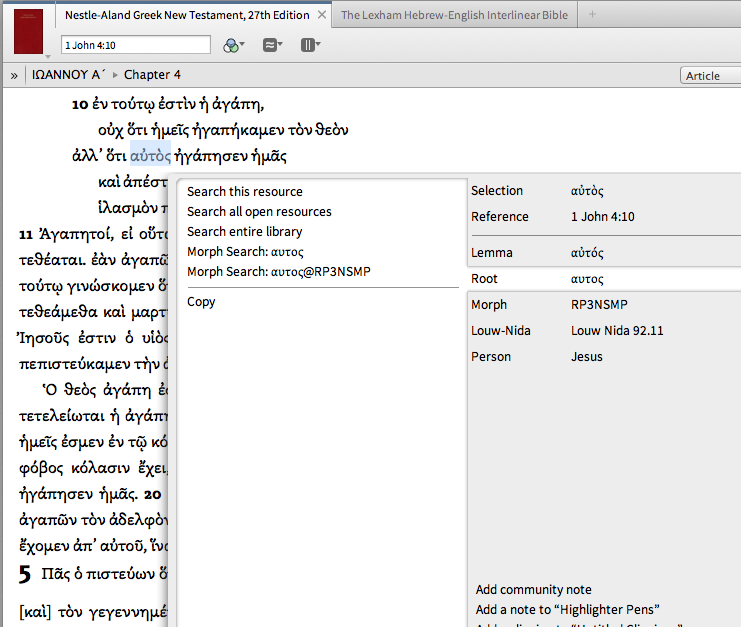
I tried to search "subject:Jesus verb:to love" but in 1 John 4:10 "He loved us" shows for God. My search is Jesus what is my mistake?
Tes,
I'm sure one of the MVP's will be by in a bit. I don't believe you've done anything wrong. I get the same result. It's possible that it is a mis-tag of the pronoun HE as it certainly looks to me that 'he' refers to God and not Jesus.
Certainly looks like a tagging error.
If you right-click on the pronoun for "he" in 1 John 4:10 you can see it is tagged as "Jesus" whereas it should relate to God as Tes suggested.
There's another interesting result shown in Ephesians 1:6 "
The UBS handbook has this to say:
In his dear Son: it was by means of Jesus Christ, God’s dear Son (see Mark 1:11, the heavenly voice at the baptism of Jesus), that God manifested his grace to mankind. The Greek uses the perfect passive participle of the verb “to love” (see RSV “the Beloved”); here only is this participle used of Christ in the New Testament. The phrase “in the beloved” may be rendered as “by means of what was done by his Son whom he loves.” In some instances, means is expressed by a term or phrase which indicates the possibility of something happening or existing. Therefore, “in the beloved” may be rendered as “God’s dear Son made this possible.”
Robert G. Bratcher and Eugene Albert Nida, A Handbook on Paul’s Letter to the Ephesians (, UBS Handbook SeriesNew York: United Bible Societies, 1993), 16.
So not clear how this should be tagged but not sure it's correct (but my knowledge of Greek is very limited!)
Graham
Certainly looks like a tagging error. If you right-click on the pronoun for "he" in 1 John 4:10 you can see it is tagged as "Jesus" whereas it should relate to God as Tes suggested.
Well this is strange, I was looking at Graham's example and saw he was using the Lexham Greek-English Interlinear: SBL Edition and right clicking and seeing the Sense tag. When I look at my Lexham I do not see that it does not have the Sense tags.
I looked at my Nestle-Aland and I see that it does have Sense tags.
I see the same behaviour with my Lexham Hebrew-English Interlinear and Lexham Hebrew bible — the original language only book is tagged the Interlinear is not.
To check the file was not corrupted I removed the Lexham Greek-English Interlinear: SBL Edition and re-downloaded the resource, no difference.
What do others see on their installations?
and the funny thing (well strange to me) is the Lexham Greek-English Interlinear New Testament (non SBL) has the 'Speaker Labels' but no sense tagging.
Is there any way to find out/know which resources are tagged and which are not?
To check the file was not corrupted I removed the Lexham Greek-English Interlinear: SBL Edition and re-downloaded the resource, no difference. What do others see on their installations?
Graham is showing off a feature revealed by v5.0a which is in beta testing.
To check the file was not corrupted I removed the Lexham Greek-English Interlinear: SBL Edition and re-downloaded the resource, no difference. What do others see on their installations? Graham is showing off a feature revealed by v5.0a which is in beta testing.
Awww - that's just plain cruel [:^)]
Awww - that's just plain cruel
But you could join the beta test - just read the warnings in the first post!
I might consider that - to do it properly though it would need to be on a different machine. I could setup a Parallels virtual machine and run it on there...
. I could setup a Parallels virtual machine and run it on there...
VM's are good - that was how I tested Windows 8 on my Win 7 machine..
Well this is strange, I was looking at Graham's example and saw he was using the Lexham Greek-English Interlinear: SBL Edition and right clicking and seeing the Sense tag. When I look at my Lexham I do not see that it does not have the Sense tags. I looked at my Nestle-Aland and I see that it does have Sense tags. I see the same behaviour with my Lexham Hebrew-English Interlinear and Lexham Hebrew bible — the original language only book is tagged the Interlinear is not. ...
...
Just to avoid terminological confusion: what Graham's example shows is the referent for this word, which comes from our Referent Database. That's different from the senses in the Bible Sense Lexicon (which are also tagged in the text, and available on the interlinear ribbon).
Most of these annotations now live on the SBLGNT versions of texts, and we'll continue to build primarily on this text going forward. Likewise with LHB.
Well this is strange, I was looking at Graham's example and saw he was using the Lexham Greek-English Interlinear: SBL Edition and right clicking and seeing the Sense tag. When I look at my Lexham I do not see that it does not have the Sense tags. I looked at my Nestle-Aland and I see that it does have Sense tags. I see the same behaviour with my Lexham Hebrew-English Interlinear and Lexham Hebrew bible — the original language only book is tagged the Interlinear is not. ... Just to avoid terminological confusion: what Graham's example shows is the referent for this word, which comes from our Referent Database. That's different from the senses in the Bible Sense Lexicon (which are also tagged in the text, and available on the interlinear ribbon). Most of these annotations now live on the SBLGNT versions of texts, and we'll continue to build primarily on this text going forward. Likewise with LHB.
HI, Sean surprsing! but what is your response to the problem?
Bump
Doing the same search as Tes, I get 1Jn 4:10 twice. Are the rest getting this?
Not in "verses" mode but yes in "analysis" mode as below
I am guessing this is because two different objects are tagged - the "addresses of John" and "John (son of Zebedee)
You can see the same thing in Ephesians 5:2 ("Paul" and "Church at Ephesus")
Good! Thanks for the clarification Graham!
You are welcome - glad to help.
The problem is still there.
I agree, so I'll set up a Bug report in the forum
I've filed a bug report for this problem.
Thank you Bradley.
Thank you Dave.
Available Now
Build your biblical library with a new trusted commentary or resource every month. Yours to keep forever.