Which Hebrew Lexicon do you find to be the most helpful?
BDB, more specifically Enhanced Brown-Driver-Briggs Hebrew and English Lexicon. It's what we used in seminary so I'm most familiar with its format. And I like that it gives you locations in the Hebrew Bible where various meanings are used.
Do you have HALOT? Wondering how it compares/contrasts to BDB. I have BDB, but was looking to see if investing in HALOT would be worth it.
I do have HALOT, but frankly I'm not a great test case because I so rarely use a Hebrew lexicon at all. I just gravitate to what's familiar when I need one. You'd best wait for some input from other people who have used both extensively and can give you a good comparison.
BDB is what people tend to start with as students, because hey, 20$. But it was written before most of the major Semitic lexicographical discoveries or studies.
I tend to HALOT myself, but also look at BDB.
HALOT, however, doesn't cite the DSS like the DCH does (though IIRC, DCH has some other problems.)
There's been discussion of revising BDB by Huehnergard and Hackett, fine Semiticists who happen to be married and at Utexas now.https://www.academia.edu/234653/2008_On_Revising_and_Updating_BDB
That would be awesome.
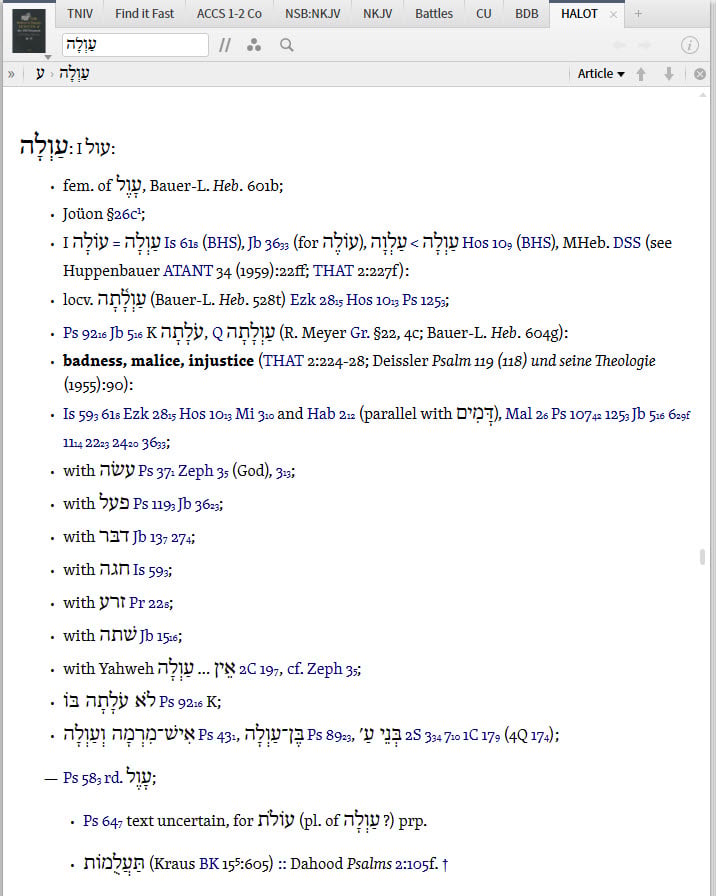
There is also a difference in format. BDB lists entries by root, HALOT by lemmas. Here are two samples for the same entry that you can compare if you'd like (randomly picked, click on the snapshots to zoom):
Halot:
BDB:
And both can benefit from the outline formatting visual filter. I personally think BDB's format benefits more from that VF:
HALOT:
HALOT is my go-to for any serious work. However, BDB is perfectly serviceable for regular exegesis.
Getting down to the guts: HALOT is rather more dependable as it delves into more evidence. BDB can be overly imaginative when it comes to root derivations. Having said that, if one encounters a rare word, or a rare sense, and the work requires academic rigour, the exegete must be prepared to look at all the evidence and form an independent conclusion apart from any lexicon.
HALOT is my go-to for any serious work. However, BDB is perfectly serviceable for regular exegesis. Getting down to the guts: HALOT is rather more dependable as it delves into more evidence. BDB can be overly imaginative when it comes to root derivations. Having said that, if one encounters a rare word, or a rare sense, and the work requires academic rigour, the exegete must be prepared to look at all the evidence and form an independent conclusion apart from any lexicon.
I tend to agree with Lee, but we'll see if that remains true when the Dictionary of Classical Hebrew is released.
Have been curious about A Concise Hebrew and Aramaic Lexicon of the Old Testament which I have. By the description "it offers everything the student needs to translate an Old Testament passage". It may be that the word student is important in there now that I think about it. Are there other reasons to make the move to a more complete Lexicon?
HALOT is my go-to default Hebrew lexicon. It's excellent.
It might be acceptable for a student if he's willing to flip a coin and take one (I thought I had this as well, but I don't see it—perhaps I hid it). If you're serious about the language, you want more than a list of glosses.
I purchased HALOT...so hopefully will be worth the investment.
Thanks everyone.
outline formatting visual filter
Well, thanks again, Rosie, I did not even know about this, this made my day!
HALOT is my go-to default Hebrew lexicon.
Mine too.
Available Now
Build your biblical library with a new trusted commentary or resource every month. Yours to keep forever.