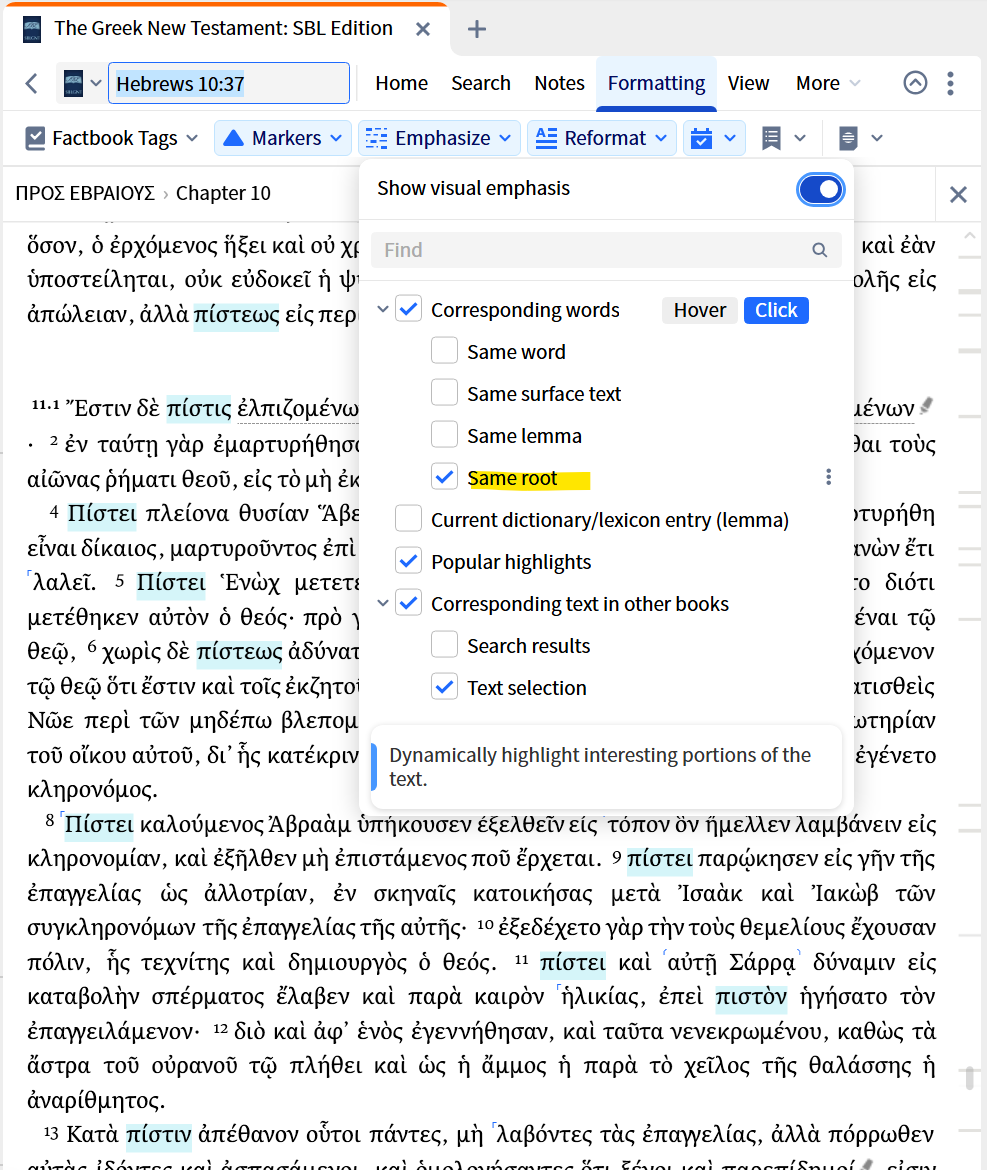
Before I explain this idea, let me share another one
I worked on this before. I pasted a Bible text and it included the source which I deleted, and then my entire post disappeared. It says at the bottom here that a draft was saved, but I see no way to recover it. So I have to duplicate the whole thing.
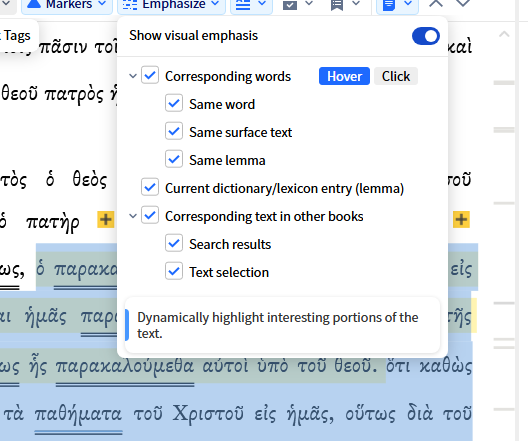
This a menu from my Bible. UBS5
Now this is the passage I was reading. Πίστει Ἑνὼχ μετετέθη τοῦ μὴ ἰδεῖν θάνατον, καὶ οὐχ ηὑρίσκετο διότι μετέθηκεν αὐτὸν ὁ θεός. πρὸ γὰρ τῆς μεταθέσεως μεμαρτύρηται εὐαρεστηκέναι τῷ θεῷ· χωρὶς δὲ πίστεως ἀδύνατον εὐαρεστῆσαι· πιστεῦσαι γὰρ δεῖ τὸν προσερχόμενον τῷ θεῷ ὅτι ἔστιν καὶ τοῖς ἐκζητοῦσιν αὐτὸν μισθαποδότης γίνεται.
Barbara Aland et al., eds., The Greek New Testament, Fifth Revised Edition (Stuttgart, Germany: Deutsche Bibelgesellschaft, 2014), Heb 11:5–6.
The noun πίστις occurs throughout Hebrews 11, and the corresponding function highlights them all at once. But its verb πιστεύω occurs in this verse. It is also a corresponding word, but it won't show up as a highlight, and it should.
The verb μετατίθημι appears twice in the first verse here, but the noun μετάθεσις is also a corresponding word, but it is not highlighted.
Another passage that comes to mind is 2 Cor 1:3-6 3Blessed be the God and Father of our Lord Jesus Christ, the Father of mercies and God of all comfort,
4who comforts us in all our affliction so that we will be able to comfort those who are in any affliction with the comfort with which we ourselves are comforted by God.
5For just as the sufferings of Christ are ours in abundance, so also our comfort is abundant through Christ.
6But if we are afflicted, it is for your comfort and salvation; or if we are comforted, it is for your comfort, which is effective in the patient enduring of the same sufferings which we also suffer;
New American Standard Bible: 1995 Update (La Habra, CA: The Lockman Foundation, 1995), 2 Co 1:3–6.
The verb παρακαλέω occurs 4 times in these verses. The noun παράκλησις occurs 6 times if you include v.7. I would like the option where they would all highlight up at the same time.
Maybe these examples are too obvious ones. Maybe a Hebrew example would be better. This idea, though I thought of this before, came while I was reading this passage, so I thought I would say something now. When I see an example in the Hebrew Bible, maybe I will suggest this again.
I remember seeing an option for the same root somewhere. That would do it. Some roots show up in nouns, verb, adjectives, and adverbs. They should all highlight at the same time.
thank you