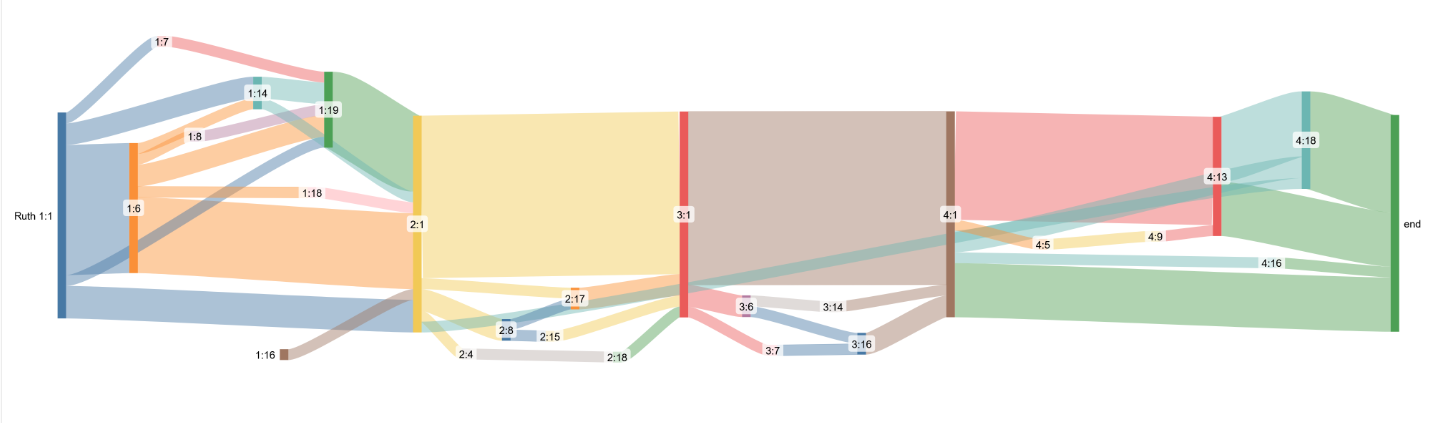
Here’s how to read this diagram: The height of each solid bar indicates the number of translations with a heading at that verse. Lighter bands emanate from each bar to where the section ends. For example, from 1:1, you can see a small band that ends at 1:7, larger bands that end at 1:14 and 2:1, and a much-larger band that ends at 1:6. The size of the bands shows the number of translations. So we can see that most translations treat 1:1-5 as a single section, and they start a new section at 1:6. Then, starting in 1:6, there’s much more variety in how long the sections are (you can see that the bands fan out to five different vertical bars).
What can we learn from this visualization? The high bars at 1:1, 2:1, 3:1, and 4:1 indicate that translations insert headings at the chapter breaks in Ruth. (Ruth is unusual in this respect; most books don’t break so cleanly and unanimously.) In chapter one, you can see somewhat-large divisions at verses 6 (Naomi hears about God’s work) and 19 (Ruth and Naomi arrive in Bethlehem). But other translations pick different divisions in chapter 1: verse 7 (Naomi starts heading out to Bethlehem), verse 8 (Naomi asks her daughters-in-law to go back, verse 14 (Ruth clings to Naomi), verse 16 (“Where you go I will go”), and verse 18 (Naomi stops asking Ruth to go back). And still other translations don’t break up chapter one at all. So different translators see different moments as deserving headings, which shapes how you read the text.
Similarly, in chapter four, many translations see 4:13 as a turning point (when Boaz officially marries Ruth). The bar at 4:18 is showing that some translations have a heading for David’s genealogy, but most don’t.